
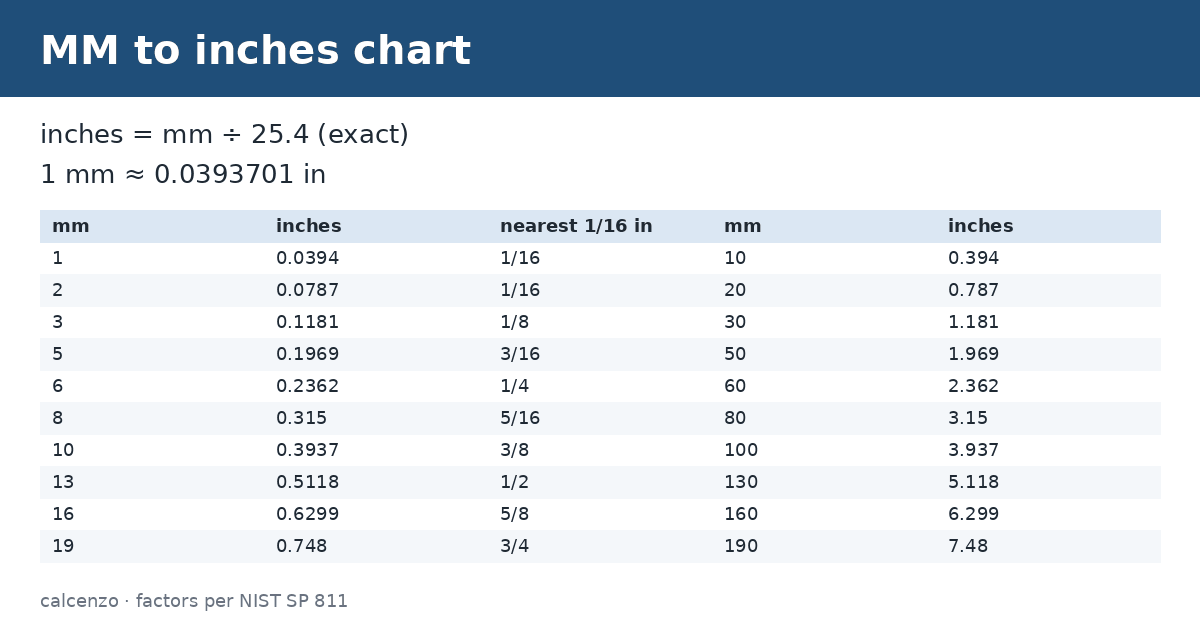
To convert mm to inches, divide by 25.4: one inch is exactly 25.4 millimeters, so 1 mm ≈ 0.0393701 in. For example, 50 mm = 1.9685 in, and 6 mm ≈ 0.2362 in, just under 1/4 in.
On this page
How to use the mm to inches converter
- Enter the length in millimeters, for example 19.
- Read the mm to inches converter result: 19 ÷ 25.4 = 0.748 in.
- For a fraction, multiply by 16 and round: 0.748 × 16 ≈ 12, so 12/16 = 3/4 in.
What is the MM to inches formula?
inches = millimeters ÷ 25.4 (≈ × 0.0393701)
The reverse is millimeters = inches × 25.4.
The inch, foot, yard and mile are defined exactly in meters (1 in = 2.54 cm, 1 ft = 0.3048 m, 1 yd = 0.9144 m, 1 mi = 1,609.344 m), so these factors are exact. The multiplier 0.0393701 is rounded to six significant digits; the mm to inches calculator uses the full-precision value.
What are millimeters and inches?
Length measures distance. The SI base unit is the meter. Since 1959 the international inch has been defined as exactly 2.54 cm, so the foot is exactly 0.3048 m and the mile exactly 1,609.344 m.
- Millimeter (mm): 1 mm = 0.001 m (Metric unit).
- Inch (in): 1 in = 0.0254 m (US/Imperial unit).
Mm to inches worked examples
- A 3 mm drill bit: 3 ÷ 25.4 = 0.11811 in
- 12 mm plywood: 12 ÷ 25.4 = 0.472441 in
- A 55 mm camera filter: 55 ÷ 25.4 = 2.16535 in
Conversion chart
| mm | in | mm | in |
|---|---|---|---|
| 0.5 | 0.0197 | 12 | 0.4724 |
| 1 | 0.0394 | 15 | 0.5906 |
| 2 | 0.0787 | 20 | 0.7874 |
| 3 | 0.1181 | 25 | 0.9843 |
| 5 | 0.1969 | 25.4 | 1 |
| 6 | 0.2362 | 30 | 1.1811 |
| 8 | 0.315 | 50 | 1.9685 |
| 10 | 0.3937 | 100 | 3.937 |
Values are rounded to four decimal places, or two for results of 100 or more.
Quick mental conversion
Divide by 25 for a quick estimate: 50 mm ≈ 2 in (exact: 1.97 in).
Nearest fractional inch
| mm | Exact inches | Nearest 1/16 in |
|---|---|---|
| 3 | 0.118 | 1/8 |
| 6 | 0.236 | 1/4 |
| 10 | 0.394 | 3/8 |
| 13 | 0.512 | 1/2 |
| 16 | 0.630 | 5/8 |
| 19 | 0.748 | 3/4 |
Metric and fractional tools are close but not interchangeable: a 13 mm wrench is slightly larger than 1/2 in (12.7 mm).
Millimeters from inches: reverse chart
Going the other way, millimeters = inches × 25.4. Common values:
| inches | millimeters |
|---|---|
| 1 | 25.4 |
| 2 | 50.8 |
| 5 | 127 |
| 10 | 254 |
| 20 | 508 |
| 50 | 1,270 |
| 100 | 2,540 |
| 500 | 12,700 |
| 1,000 | 25,400 |
Metric and SAE wrench sizes
Some metric sockets nearly match inch sizes; others do not:
| Metric wrench | In inches | Nearest SAE size |
|---|---|---|
| 8 mm | 0.315 | 5/16 in (0.3125) |
| 10 mm | 0.394 | — |
| 13 mm | 0.512 | 1/2 in (0.500) |
| 16 mm | 0.63 | 5/8 in (0.625) |
| 19 mm | 0.748 | 3/4 in (0.750) |
A 13 mm socket is about 0.012 in larger than 1/2 in and may slip on a tight bolt, so use the matching system when you can.
Rainfall from mm to inches
Weather services outside the US report rain in millimeters. 25.4 mm of rain is 1 in; 10 mm is about 0.39 in, and 100 mm about 3.94 in. Because 1 mm of rain on 1 m² is 1 liter, 1 in of rain on 1 m² is 25.4 L. Use the inches to mm converter for the reverse and the cm to inches converter for larger lengths.
Drill bits, phones and paper
Metric fasteners and drill bits often need an imperial match. A 6 mm bit is 0.236 inches, a hair larger than a 15/64 bit at 0.234 inches. For clearance holes, round up to the next fractional size; for tapped holes, follow the tap chart rather than the nearest fraction.
Small dimensions are common on spec sheets. A phone that is 7.8 mm thick is about 0.31 inches. A sheet of office paper at 0.1 mm is about 0.004 inches, which machinists call four thou. The mm to inches factor is exact: divide by 25.4.
When reading a ruler marked in sixteenths, 1 mm is a little less than 1/16 inch (1.59 mm), which is a handy mental check.
Rain gauges in metric countries report millimeters, so 25 mm of rain is about one inch.
Jewelry is sized in millimeters too. A ring band 4 mm wide is about 0.16 inches, and a 6 mm bead is just under a quarter inch. Watch cases are almost always given in mm, so a 40 mm watch is about 1.57 inches across.
Related converters and calculators
Related conversions:
- Inches to mm: in to mm
- cm to inches: cm to in
- Inches to cm: in to cm
- Inches to feet: in to ft
- Length converter: all length units
Sources
NIST Special Publication 811, Appendix B; NIST: SI units – length.
Questions about this calculator
How many mm are in an inch?
25.4 mm exactly.
How do I convert mm to inches?
Divide by 25.4. For example, 30 mm = 1.1811 in.
What is 10 mm in inches?
0.3937 in, about 3/8 in (0.375).
How do I get a mm to inches fraction?
Divide by 25.4, multiply by 16 and round: 8 mm ≈ 0.315 in ≈ 5/16 in.
What is 1 mm of rain in inches?
About 0.0394 in.
Check the assumptions and units before relying on a result. Financial, tax and health estimates do not replace advice for your individual circumstances.
Report a calculation issue