
A mass calculator finds an object’s mass by multiplying its density by its volume. Formula: Mass = density × volume (both ≥ 0). A 10 cm³ block of aluminum at 2.70 g/cm³ has a mass of 27 g.
On this page
How to use the mass calculator
- Enter the density.
- Enter the volume in the matching unit.
- Read the mass in the matching mass unit.
How the mass calculator works
The mass calculator multiplies density by volume:
- mass = density × volume
- m = ρ × V
The tool rejects negative density or volume and does not convert units, so the answer comes out in whatever units match your inputs. Density in g/cm³ times volume in cm³ gives grams; kg/m³ times m³ gives kilograms; kg/L times liters gives kilograms. Keep the volume unit the same as the one in the density.
Mass calculator worked example
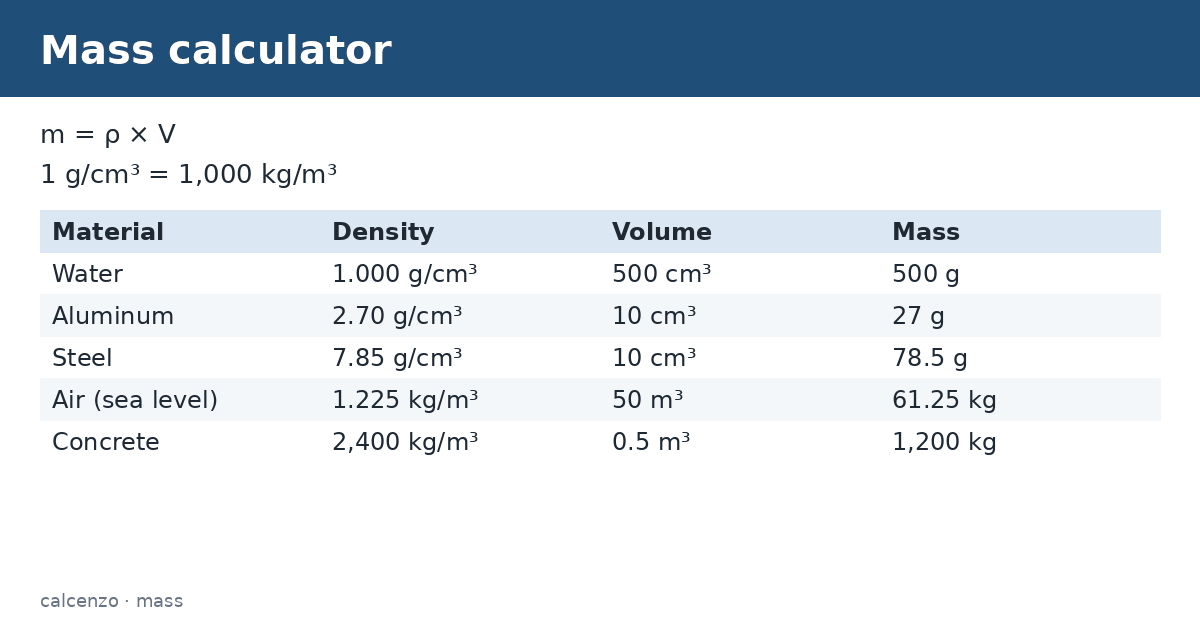
A 10 cm³ block of aluminum, density 2.70 g/cm³, has a mass of 2.70 × 10 = 27 g. The same size block of steel at 7.85 g/cm³ has a mass of 78.5 g. For a 0.5 m³ concrete slab at about 2,400 kg/m³, the mass calculator gives 1,200 kg. Water is the easy reference: about 1 g per cm³, so 500 mL weighs about 500 g.
| Material | Density | Volume | Mass |
|---|---|---|---|
| Water | 1.000 g/cm³ | 500 cm³ | 500 g |
| Aluminum | 2.70 g/cm³ | 10 cm³ | 27 g |
| Steel | 7.85 g/cm³ | 10 cm³ | 78.5 g |
| Air (sea level) | 1.225 kg/m³ | 50 m³ | 61.25 kg |
| Concrete | 2,400 kg/m³ | 0.5 m³ | 1,200 kg |
Units and conversions
NIST defines the kilogram as the SI unit of mass. Useful links between units: 1 g/cm³ = 1,000 kg/m³ = 1 kg/L, and 1 m³ = 1,000 L = 1,000,000 cm³. If you have density in kg/m³ and volume in liters, divide the liters by 1,000 first. For US units, density in lb/ft³ times volume in ft³ gives pounds; water is about 62.4 lb/ft³.
Mass versus weight
Mass is the amount of matter and does not change with location. Weight is the force of gravity on that mass: weight = mass × g, where g is about 9.81 m/s² on Earth. A 27 g aluminum block weighs about 0.26 newtons on Earth and about one-sixth of that on the Moon, but its mass is 27 g in both places. In daily life people say “weight” when they mean mass, and scales are calibrated to show mass.
Density changes with conditions
Densities in tables are for set conditions. The USGS notes that pure water is densest, about 1.000 g/cm³, near 4 °C and becomes less dense as it warms. Gases change a lot with temperature and pressure. For precise work use a density measured at your conditions in the mass calculator.
Everyday uses
Knowing mass from density and volume solves many practical problems. Builders order concrete by volume but need its mass to check that a floor or trailer can carry it: a cubic yard of concrete, about 0.76 m³, weighs roughly 1,800 kg. Gardeners buying topsoil, shippers estimating freight and cooks scaling recipes all use the same relationship. In the kitchen, a cup of water is about 237 g, but a cup of flour is only about 120 to 130 g because flour is much less dense and full of air.
Engineers also use the formula in reverse. If you know the mass and volume, density = mass ÷ volume, which can identify a material: a 27 g block that displaces 10 cm³ of water has a density of 2.70 g/cm³, matching aluminum. Archimedes is said to have used a similar idea to test whether a crown was pure gold, which has a density of about 19.3 g/cm³.
For hollow objects, use the volume of the material itself, not the outside size. A steel pipe’s mass depends on the volume of the wall, which is the outer cylinder minus the inner one. Measure both diameters and the length, work out each volume, subtract, and then multiply by the density of steel to get the mass. Then add the mass of any fittings.
Related converters and calculators
Related calculators:
- Density calculator: density
- Volume calculator: volume
- Weight converter: mass units
- Molecular weight calculator: chemistry
Sources
NIST: SI units – mass; USGS Water Science School: Water density.
Formula and method
Mass = density × volume (both ≥ 0).
Rejects negative density or volume. No unit conversion: keep units consistent (for example g/cm³ with cm³ gives grams).
Questions about this calculator
What is the formula for mass?
Mass = density × volume.
What units does it use?
The units you enter; keep them matched.
How much does 1 liter of water weigh?
About 1 kg.
Is mass the same as weight?
No, weight is mass times gravity.
Can density change?
Yes, with temperature and pressure.
Check the assumptions and units before relying on a result. Financial, tax and health estimates do not replace advice for your individual circumstances.
Report a calculation issue