
A weight converter changes a mass from one unit to another, such as kilograms to pounds or stones to kilograms. Formula: kg = lb × 0.45359237; 1 stone = 14 lb. 70 kg is 154.32 pounds, and one stone is 6.35 kilograms.
On this page
How to use the weight converter
- Enter the value.
- Choose the unit to convert from.
- Choose the unit to convert to.
- Read the converted mass.
How the weight converter works
This weight converter, also a mass converter, supports 16 units, including milligrams, grams, kilograms, metric tonnes, ounces, pounds, stones, short and long tons, troy ounces, grains and carats. It converts your value to kilograms with the exact factor for each unit, then converts from kilograms to the target unit. The default converts 70 kilograms to pounds, which gives 154.3236 lb.
Exact definitions
The avoirdupois pound is exactly 0.45359237 kilograms, and the ounce is one sixteenth of it. A stone is 14 pounds, or 6.35029318 kg. A short ton, used in the US, is 2,000 pounds, or 907.18474 kg, and a long ton, used in the UK, is 2,240 pounds, or 1,016.0469088 kg. A metric tonne is 1,000 kg. A grain is exactly 64.79891 milligrams, and the troy ounce is 480 grains, or 31.1034768 grams. The metric carat is exactly 200 milligrams.
Weight converter worked example
A person who weighs 11 stone 4 pounds weighs 158 pounds, and 158 × 0.45359237 = 71.6676 kg. A one-ounce gold coin is a troy ounce, 31.1035 grams, which is about 1.0971 ordinary ounces. A 2-carat diamond weighs 0.4 grams. The weight converter handles each of these in one step.
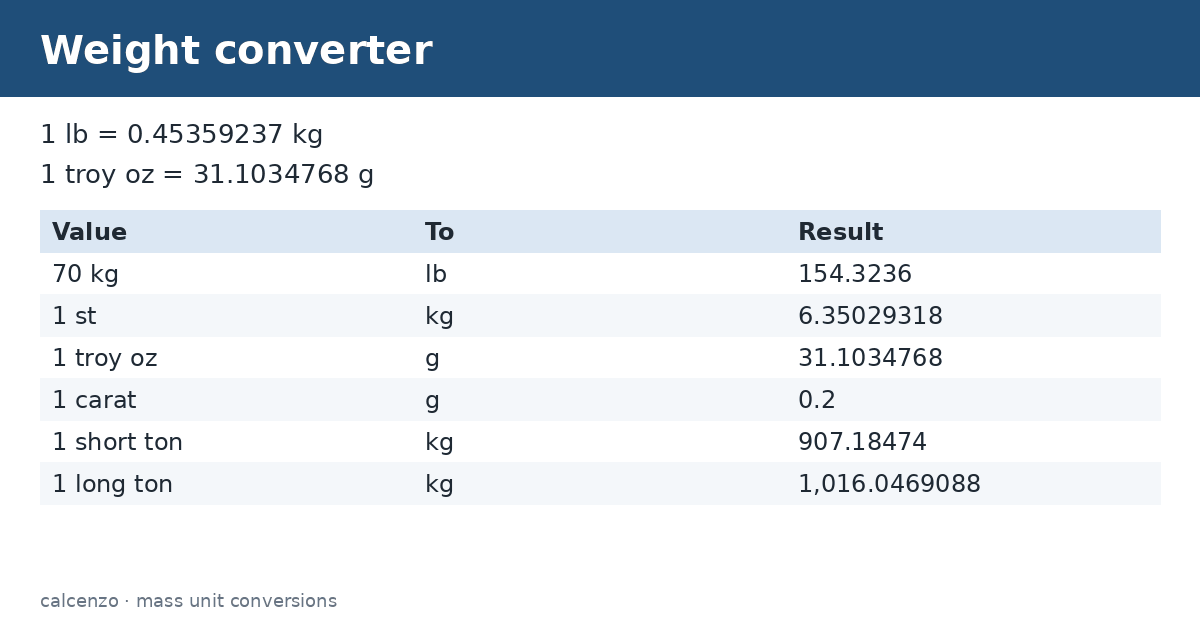
| Value | To | Result |
|---|---|---|
| 70 kg | lb | 154.3236 |
| 1 st | kg | 6.35029318 |
| 1 troy oz | g | 31.1034768 |
| 1 carat | g | 0.2 |
| 1 short ton | kg | 907.18474 |
| 1 long ton | kg | 1,016.0469088 |
Troy versus avoirdupois
Precious metals are priced in troy ounces, which are about 9.7% heavier than the avoirdupois ounces used for food and postage. A troy pound has 12 troy ounces, not 16, so it is lighter than an ordinary pound. Mixing the two is a common and costly mistake; choose the troy ounce unit when converting bullion weights.
Which ton?
“Ton” can mean three different masses. In the US it usually means the short ton of 2,000 pounds; in older British use, the long ton of 2,240 pounds; and in most of the world, the metric tonne of 1,000 kilograms. Shipping documents and engineering specifications should state which one is meant. The weight converter lists all three separately.
Mass and weight
In science, mass is measured in kilograms and weight is a force measured in newtons. In everyday use, and on scales calibrated for Earth’s gravity, the terms are interchangeable, and this tool follows everyday use. A 1 kg mass weighs about 9.81 newtons at the surface of the Earth.
Everyday weight converter examples
Airline checked-bag limits of 23 kg are about 50.7 pounds. A newborn weighing 7 pounds 8 ounces weighs 3.40 kilograms. Gym plates marked 20 kg are about 44.09 pounds, and a 45-pound plate is about 20.41 kilograms. A recipe calling for 200 grams of sugar needs about 7.05 ounces. The weight converter gives each answer to full precision, and you can round to suit the task.
Choosing the right unit
Pick a unit that matches how the result will be used. Medicine doses use milligrams, grams suit cooking, kilograms and pounds suit body weight and luggage, and tonnes or tons suit vehicles and freight. When reporting a converted value, keep about the same number of significant figures as the original measurement so you do not imply false precision. A bathroom scale reading 72.4 kg, for example, converts sensibly to 159.6 pounds rather than 159.6157 pounds.
Tips
- Use troy ounces for gold and silver.
- Check which ton a document means.
- For body weight in stones, convert stones and pounds to pounds first.
- Round to the precision of your scale.
Related converters and calculators
Related calculators:
- kg to lbs: kilograms
- lbs to kg: pounds
- Grams to ounces: grams
- Ounces to pounds: ounces
Sources
NIST: SI units – mass; NIST Guide to the SI, Appendix B.8: Factors for units listed alphabetically.
Formula and method
Target = value × factor(source) ÷ factor(target); factors are in kilograms.
Your value is multiplied by the source unit factor and divided by the target unit factor (both expressed in the base unit). Results are shown rounded; the calculation uses full precision.
Questions about this calculator
How many kg in a stone?
6.35029318.
Is a troy ounce heavier than an ounce?
Yes, about 31.10 g versus 28.35 g.
What is a short ton?
2,000 pounds.
What is a carat?
Exactly 200 milligrams.
Is the pound exact?
Yes, 0.45359237 kg.
Check the assumptions and units before relying on a result. Financial, tax and health estimates do not replace advice for your individual circumstances.
Report a calculation issue