
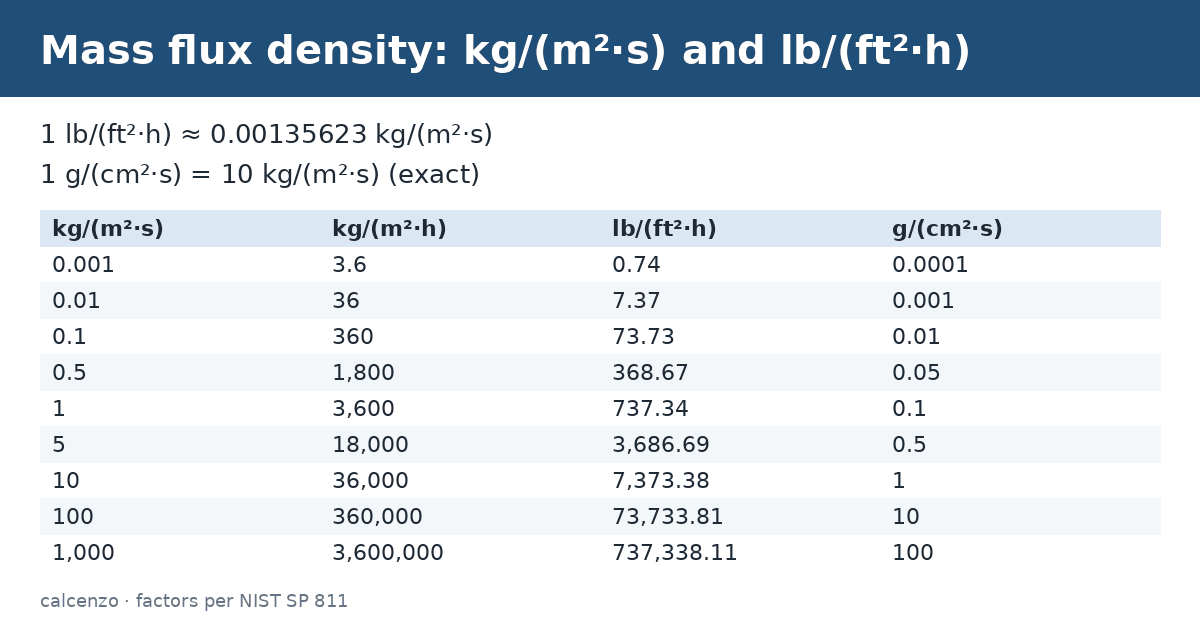
This mass flux density converter changes mass flow per unit area between kilograms per second per square meter, grams per second per square centimeter, kilograms per hour per square meter and pounds per hour or per second per square foot. Formula: 1 g/(cm²·s) = 10 kg/(m²·s); 1 kg/(m²·h) = 1/3600 kg/(m²·s). The SI unit is kg/(m²·s). 1 g/(cm²·s) is exactly 10 kg/(m²·s), and 1 lb/(ft²·h) is about 0.00135623 kg/(m²·s).
On this page
How to use the mass flux density converter
- Enter the value, for example 1,000 kg/(m²·h) from a dryer specification.
- In the mass flux density converter, choose its unit and the target unit.
- Read the mass flux density converter result: 1,000 kg/(m²·h) ≈ 0.278 kg/(m²·s) ≈ 204.8 lb/(ft²·h).
For kg/m²s to lb/ft²h, multiply by 737.338.
What is mass flux density?
Mass flux density is mass flow per unit area per unit time, in kg/(s·m²). It is used in evaporation, drying, filtration and process engineering.
Conversion formula
The mass flux density converter stores every unit as a multiple of the base unit, the kilogram per second square meter (kg/(s·m²)). To convert:
value in target unit = value × (factor of source unit ÷ factor of target unit)
where each factor is the size of the unit in kilograms per second square meter.
Common mass flux density conversions
| From | To | 1 unit equals |
|---|---|---|
| pound per hour square foot (lb/(h·ft²)) | kilogram per second square meter (kg/(s·m²)) | 0.00135623 kg/(s·m²) |
| gram per second square centimeter (g/(s·cm²)) | kilogram per second square meter (kg/(s·m²)) | 10 kg/(s·m²) |
Mass flux density converter worked example
Convert 25 pounds per hour square foot to kilograms per second square meter:
- Factor of lb/(h·ft²) = 0.0013562299 kg/(s·m²)
- Factor of kg/(s·m²) = 1 kg/(s·m²)
- 25 × 0.0013562299 ÷ 1 = 0.03390575 kg/(s·m²)
Mass flux density unit reference
| Unit | Symbol | Group | Equals (kg/(s·m²)) |
|---|---|---|---|
| Kilogram per Second Square Meter | kg/(s·m²) | SI | 1 |
| Gram per Second Square Centimeter | g/(s·cm²) | CGS | 10 |
| Kilogram per Hour Square Meter | kg/(h·m²) | Metric | 0.0002777777778 |
| Pound per Hour Square Foot | lb/(h·ft²) | US/Imperial | 0.001356229918 |
| Pound per Second Square Foot | lb/(s·ft²) | US/Imperial | 4.882427595 |
Reverse factors for each mass flux density unit
The reference table gives each unit in kilogram per second square meters. To go the other way, divide by that factor; the list below does the division for you.
- Kilogram per Second Square Meter (kg/(s·m²)), SI: 1 kg/(s·m²) = 1 kg/(s·m², so 1 kg/(s·m² = 1 kg/(s·m²).
- Gram per Second Square Centimeter (g/(s·cm²)), CGS: 1 g/(s·cm²) = 10 kg/(s·m², so 1 kg/(s·m² = 0.1 g/(s·cm²).
- Kilogram per Hour Square Meter (kg/(h·m²)), Metric: 1 kg/(h·m²) = 0.0002777778 kg/(s·m², so 1 kg/(s·m² = 3,600 kg/(h·m²).
- Pound per Hour Square Foot (lb/(h·ft²)), US/Imperial: 1 lb/(h·ft²) = 0.00135623 kg/(s·m², so 1 kg/(s·m² = 737.3381 lb/(h·ft²).
- Pound per Second Square Foot (lb/(s·ft²)), US/Imperial: 1 lb/(s·ft²) = 4.882428 kg/(s·m², so 1 kg/(s·m² = 0.2048161 lb/(s·ft²).
Mass flux examples
Mass flux ranges over many orders of magnitude, from slow evaporation to pipe flow. The pipe and duct rows use G = ρ × v:
| Situation | kg/(m²·s) | kg/(m²·h) | lb/(ft²·h) |
|---|---|---|---|
| Evaporation of 5 mm of water per day | 0.000058 | 0.208 | 0.043 |
| Water at 1 m/s in a pipe (ρ ≈ 1,000 kg/m³) | 1,000 | 3,600,000 | 737,338.107 |
| Air at 5 m/s in a duct (ρ ≈ 1.2 kg/m³) | 6 | 21,600 | 4,424.029 |
Mass flux density units combine mass, area and time, so check all three when reading a datasheet.
Mass flux, velocity and mass flow
Mass flux G equals density times velocity, and mass flow is G times the flow area. A 0.01 m² pipe carrying water at 1,000 kg/(m²·s) passes 10 kg/s. Convert the total with the mass flow rate converter.
Where large values appear
Mass flux is common in heat exchanger and boiler design. A steam generator tube might run at around one million lb/(h·ft²). The mass flux density converter turns that into about 1,356 kg/(m²·s), which is a more familiar size for SI users.
A quick worked case: 0.5 kg/s of water flowing through a pipe with a 50 mm inside diameter. The flow area is about 0.00196 m², so the mass flux is about 255 kg/(m²·s). Divide by water’s density of 1,000 kg/m³ and the average velocity is about 0.25 m/s.
The most common slip is mixing area units. Square centimeters and square meters differ by 10,000, so check that the area unit on both sides matches the label.
Dryer and membrane specs often use kg/(m²·h), so divide by 3,600 to reach kg/(m²·s) before comparing with design tables.
Related converters and calculators
Related flow tools:
- Mass flow rate converter: kg/h and lb/h
- Flow rate converter: gpm, L/min, m³/h
- Density converter: kg/m³ and g/cm³
- Area converter: m² and ft²
- Heat flux converter: W/m²
Sources
NIST Special Publication 811, Appendix B; BIPM: SI Brochure.
Questions about this calculator
What is mass flux density?
Mass flow per unit area per unit time, in kg/(m²·s) in SI.
How do I convert kg/m²s to lb/ft²h?
Multiply by 737.338. For example, 0.5 kg/(m²·s) = 368.7 lb/(ft²·h).
How do I convert g/cm²s to kg/m²s?
Multiply by 10. For example, 0.2 g/(cm²·s) = 2 kg/(m²·s).
How do I convert kg/m²h to kg/m²s?
Divide by 3,600. For example, 720 kg/(m²·h) = 0.2 kg/(m²·s).
How is mass flux related to velocity?
G = ρ × v. Water at 2 m/s has a mass flux of about 2,000 kg/(m²·s).
Check the assumptions and units before relying on a result. Financial, tax and health estimates do not replace advice for your individual circumstances.
Report a calculation issue