
This density converter changes a mass density between kilograms per cubic meter, grams per cubic centimeter, grams per milliliter, pounds per cubic foot, pounds per gallon and other units. Formula: kg/m³ = g/cm³ × 1000. All values go through kg/m³, the SI unit. 1 g/cm³ equals exactly 1,000 kg/m³ and is the same as 1 g/mL; 1 lb/ft³ is about 16.0185 kg/m³.
On this page
How to use the density converter
- Enter the density, for example 7.85 for steel in g/cm³.
- In the density converter, choose its unit and the target unit, such as g/cm³ to kg/m³.
- Read the density converter result: 7.85 g/cm³ = 7,850 kg/m³.
For kg/m³ to g/cm³, divide by 1,000. Density changes with temperature, so note the temperature with any measured value.
What is density?
Density is mass per unit volume. The SI unit is the kilogram per cubic meter (kg/m³). Water at about 4 °C has a density close to 1,000 kg/m³, which is 1 g/cm³ or about 62.4 lb/ft³.
Conversion formula
The density converter stores every unit as a multiple of the base unit, the kilogram per cubic meter (kg/m³). To convert:
value in target unit = value × (factor of source unit ÷ factor of target unit)
where each factor is the size of the unit in kilograms per cubic meter.
Common density conversions
| From | To | 1 unit equals |
|---|---|---|
| gram per cubic centimeter (g/cm³) | kilogram per cubic meter (kg/m³) | 1,000 kg/m³ |
| pound per cubic foot (lb/ft³) | kilogram per cubic meter (kg/m³) | 16.01846 kg/m³ |
| kilogram per cubic meter (kg/m³) | pound per US gallon (lb/gal) | 0.008345404 lb/gal |
| gram per liter (g/L) | kilogram per cubic meter (kg/m³) | 1 kg/m³ |
Density converter worked example
Convert 25 grams per cubic centimeter to kilograms per cubic meter:
- Factor of g/cm³ = 1,000 kg/m³
- Factor of kg/m³ = 1 kg/m³
- 25 × 1,000 ÷ 1 = 25,000 kg/m³
Density unit reference
| Unit | Symbol | Group | Equals (kg/m³) |
|---|---|---|---|
| Kilogram per Cubic Meter | kg/m³ | SI | 1 |
| Gram per Cubic Centimeter | g/cm³ | Metric | 1,000 |
| Gram per Liter | g/L | Metric | 1 |
| Kilogram per Liter | kg/L | Metric | 1,000 |
| Pound per Cubic Foot | lb/ft³ | US/Imperial | 16.01846337 |
| Pound per US Gallon | lb/gal | US | 119.8264273 |
| Ounce per Cubic Inch | oz/in³ | US/Imperial | 1,729.994045 |
| Tonne per Cubic Meter | t/m³ | Metric | 1,000 |
| Slug per Cubic Foot | slug/ft³ | US Engineering | 515.3788181 |
Reverse factors for each density unit
The reference table gives each unit in kilogram per cubic meters. To go the other way, divide by that factor; the list below does the division for you.
- Gram per Cubic Centimeter (g/cm³), Metric: 1 g/cm³ = 1,000 kg/m³, so 1 kg/m³ = 0.001 g/cm³.
- Gram per Liter (g/L), Metric: 1 g/L = 1 kg/m³, so 1 kg/m³ = 1 g/L.
- Kilogram per Liter (kg/L), Metric: 1 kg/L = 1,000 kg/m³, so 1 kg/m³ = 0.001 kg/L.
- Pound per Cubic Foot (lb/ft³), US/Imperial: 1 lb/ft³ = 16.01846 kg/m³, so 1 kg/m³ = 0.06242796 lb/ft³.
- Pound per US Gallon (lb/gal), US: 1 lb/gal = 119.8264 kg/m³, so 1 kg/m³ = 0.008345404 lb/gal.
- Ounce per Cubic Inch (oz/in³), US/Imperial: 1 oz/in³ = 1,729.994 kg/m³, so 1 kg/m³ = 0.0005780367 oz/in³.
- Tonne per Cubic Meter (t/m³), Metric: 1 t/m³ = 1,000 kg/m³, so 1 kg/m³ = 0.001 t/m³.
- Slug per Cubic Foot (slug/ft³), US Engineering: 1 slug/ft³ = 515.3788 kg/m³, so 1 kg/m³ = 0.00194032 slug/ft³.
Common material densities
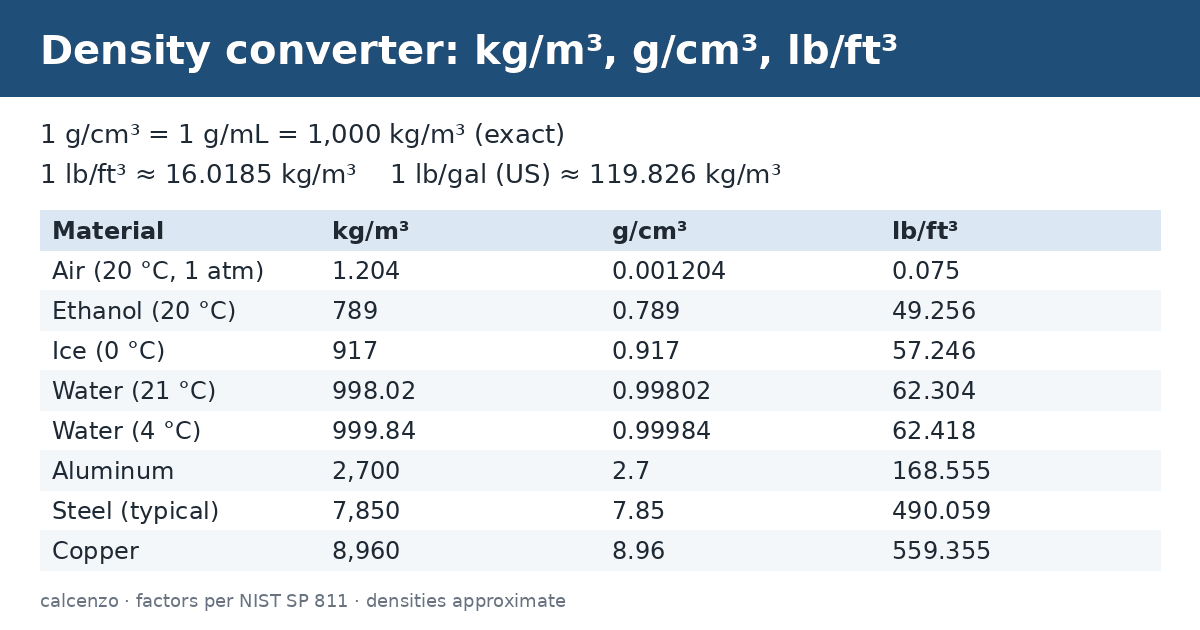
Approximate densities of familiar materials near room temperature unless stated. Exact values depend on temperature, purity and alloy:
| Material (approximate) | kg/m³ | g/cm³ | lb/ft³ |
|---|---|---|---|
| Air (20 °C, 1 atm) | 1.204 | 0.001204 | 0.075 |
| Ethanol (20 °C) | 789 | 0.789 | 49.256 |
| Ice (0 °C) | 917 | 0.917 | 57.246 |
| Water (21 °C) | 998.02 | 0.99802 | 62.304 |
| Water (4 °C) | 999.84 | 0.99984 | 62.418 |
| Aluminum | 2,700 | 2.7 | 168.555 |
| Steel (typical) | 7,850 | 7.85 | 490.059 |
| Copper | 8,960 | 8.96 | 559.355 |
The density of water is highest near 4 °C, just under 1,000 kg/m³, which is why 1 g/cm³ is a convenient reference.
Using density to find mass or volume
Density links mass and volume: mass = density × volume. A 2 m³ block of aluminum at 2,700 kg/m³ has a mass of 5,400 kg. For lb/ft³ to kg/m³, multiply by 16.0185; for US lb/gal to kg/m³, multiply by 119.826. The density calculator works out density from a measured mass and volume.
Floating, sinking and buoyancy
An object floats when its average density is lower than the fluid around it. Fresh water is about 1,000 kg/m³ and seawater about 1,025 kg/m³. Ice at 917 kg/m³ floats with about 917 ÷ 1,025 = 89.5% of its volume below the surface of the sea. The density converter puts values like these in g/cm³ or lb/ft³ when comparing tables from different sources; water is about 62.43 lb/ft³.
Related converters and calculators
Related tools for mass and volume:
- Density calculator: from mass and volume
- Specific volume converter: m³/kg, the inverse of density
- Weight converter: kg and lb
- Volume converter: liters, gallons, ft³
- Mass concentration converter: mg/L and g/L
Sources
NIST Special Publication 811, Appendix B; USGS Water Science School: Water density.
Questions about this calculator
What is the SI unit of density?
Kilograms per cubic meter (kg/m³).
How do I convert g/cm³ to kg/m³?
Multiply by 1,000. For example, 2.7 g/cm³ = 2,700 kg/m³.
How do I convert kg/m³ to g/cm³?
Divide by 1,000. For example, 1,250 kg/m³ = 1.25 g/cm³.
How do I convert lb/ft³ to kg/m³?
Multiply by 16.0185. For example, 62.4 lb/ft³ = 999.6 kg/m³.
What is the density of water?
About 998.0 kg/m³ at 21 °C and 999.84 kg/m³ at 4 °C (USGS), close to 1 g/cm³ or 62.4 lb/ft³.
Is g/mL the same as g/cm³?
Yes. One milliliter is exactly one cubic centimeter, so the values are identical.
Check the assumptions and units before relying on a result. Financial, tax and health estimates do not replace advice for your individual circumstances.
Report a calculation issue