
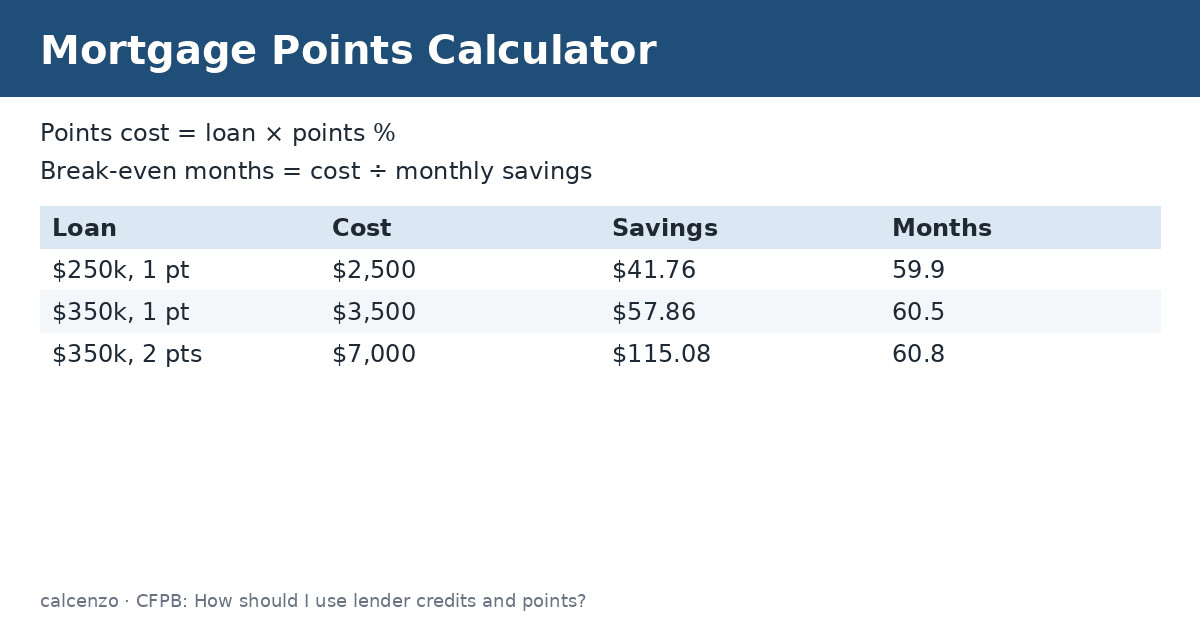
A mortgage points calculator tells you how long it takes for the lower payment from discount points to pay back what the points cost at closing. Formula: Points cost = loan × points %; monthly savings = PMT(rate without points) − PMT(rate with points); break-even months = cost ÷ savings. One point on a $350,000, 30-year loan costs $3,500; if it cuts the rate from 6.75% to 6.5%, you save $57.86 a month and break even after 60.5 months.
On this page
How to use the mortgage points calculator
- Enter the loan amount.
- Enter the number of points the lender quotes. Fractions are fine, such as 0.5 or 1.375.
- Enter the rate without points and the rate with points from the same Loan Estimate date.
- Enter the term.
The mortgage points calculator shows the points cost, both payments, the monthly savings and the break-even month.
What formula does the mortgage points calculator use?
The CFPB explains that one point equals one percent of the loan amount, so the cost is loan × points ÷ 100. Each payment uses the standard amortizing formula. Break-even months = points cost ÷ monthly savings. The simple break-even ignores taxes and what the cash could earn elsewhere, which tends to make points look a little better than they are.
Mortgage points calculator worked example
Results from the mortgage points calculator on 30-year loans:
| Loan | Points (cost) | Rates | Monthly savings | Break-even |
|---|---|---|---|---|
| $350,000 | 1 ($3,500) | 6.75% to 6.50% | $57.86 | 60.5 months |
| $350,000 | 2 ($7,000) | 6.75% to 6.25% | $115.08 | 60.8 months |
| $250,000 | 1 ($2,500) | 7.00% to 6.75% | $41.76 | 59.9 months |
In each case you need to keep the loan about five years before the points pay off. Sell or refinance sooner and you lose money on them.
When buying points makes sense
The CFPB says points can be a good choice if you plan to keep the loan for a long time. If you are not sure how long you will stay in the home or when you might refinance, it may be better not to pay points, especially if the cash would leave you with thin savings. Ask the loan officer for two quotes on the same day, one with and one without points, and put both into the mortgage points calculator.
Total savings after the break-even point
Break-even tells you when you get your money back, not how much you save in total. In the first example, $57.86 a month over 30 years is about $20,830 of lower payments for a $3,500 cost, but only if you keep the loan for its full term. Most people sell or refinance well before that, so think about a realistic holding period. Multiply the monthly savings by the months you expect to keep the loan and subtract the points cost; if the result is small or negative, skip the points.
Also remember that money paid for points is money you cannot put toward a larger down payment or an emergency fund. On a tight budget, keeping cash on hand can matter more than a slightly lower rate.
Lender credits: points in reverse
Lender credits work the other way: you take a higher rate and the lender covers part of your closing costs. That can suit someone who expects to move or refinance within a few years. Enter the credit as the cost and swap the two rates to see how long it takes before the higher payment outweighs the credit.
Common mistakes to avoid
Common mistakes: comparing a points quote and a no-points quote taken on different days, when rates may have moved; forgetting that points also show up in the APR; and assuming you will keep the loan for 30 years. Another is mixing up discount points with origination fees. Both can be shown as a percent of the loan, but only discount points lower the rate. Ask the lender to label each charge clearly.
Where to find points on your Loan Estimate
Points appear in section A, Origination Charges, of the Loan Estimate as a percent of the loan and a dollar amount. Make sure the dollar figure matches loan × points, and compare offers from more than one lender. Then rerun the mortgage points calculator for each offer.
Estimates for education only, not tax, legal or financial advice. Check current rules with the tax authority or a qualified adviser.
Related converters and calculators
Related calculators:
- Mortgage calculator: monthly payment
- Refinance calculator: refinance savings
- Amortization calculator: payment schedule
Sources
CFPB: How should I use lender credits and points?.
Questions about this calculator
How much does one mortgage point cost?
One point is 1% of the loan amount, so $3,500 on a $350,000 loan.
How much does a point lower the rate?
It varies by lender and day. Compare a quote with points and one without on the same date.
What is a good break-even period?
Shorter than the time you expect to keep the loan. In the examples on this page it is about 60 months.
Can I buy half a point?
Yes. The CFPB notes points do not have to be round numbers, such as 0.5 or 1.375 points.
What are lender credits?
The reverse of points: a higher rate in exchange for help with closing costs.
Check the assumptions and units before relying on a result. Financial, tax and health estimates do not replace advice for your individual circumstances.
Report a calculation issue