
A period calculator predicts the start and end dates of your next menstrual period from your last period and usual cycle. Formula: Next start = LMP + cycle days. Expected end = next start + (period length – 1). A period on November 1 with a 28-day cycle means the next is due November 29.
On this page
How to use the period calculator
- Enter the first day of your last period.
- Enter your average cycle length.
- Enter how many days your period usually lasts.
- Read the predicted dates.
How the period calculator works
The period calculator predicts when your next menstrual period should start and end. It adds your average cycle length to the first day of your last period to find the next start date, then adds your usual period length, minus one day, to estimate when it ends. With a period that starts on November 1 and a 28-day cycle, the next one is due on November 29. It accepts cycles of 20 to 45 days and periods of 1 to 14 days.
Period calculator worked example
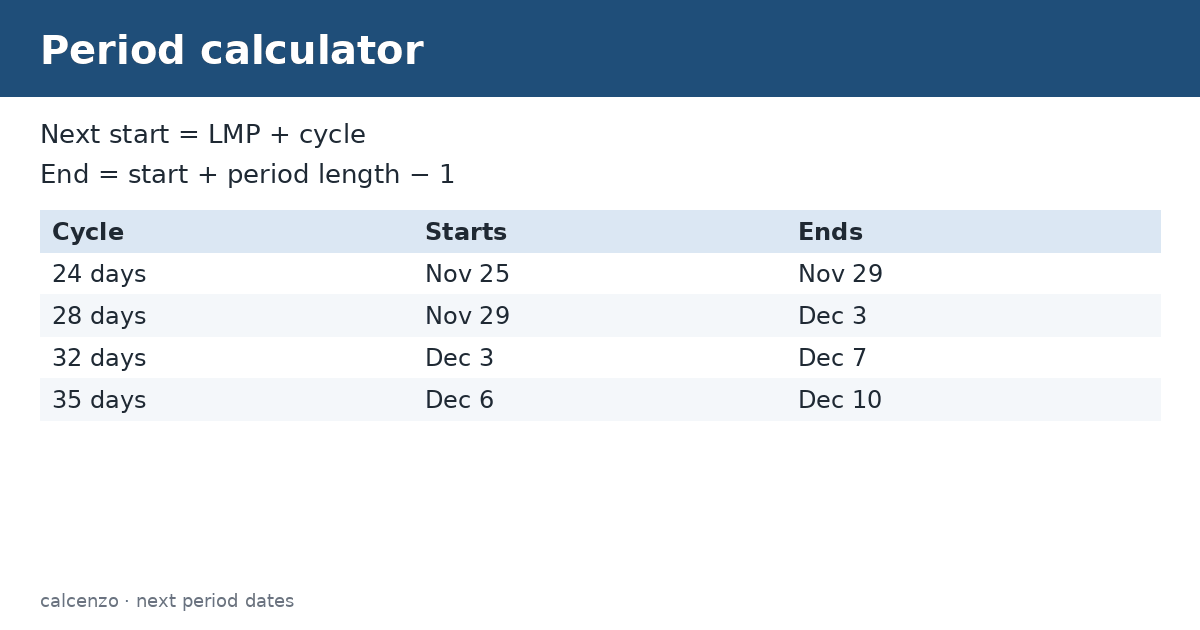
Your last period began on November 1, 2026, lasts 5 days, and your cycles average 28 days. The period calculator predicts the next period from November 29 to December 3. With a 32-day cycle it would start on December 3. The table shows the start and end dates for several cycle lengths with a 5-day period.
| Cycle length | Next period starts | Ends (5 days) |
|---|---|---|
| 24 days | Nov 25 | Nov 29 |
| 28 days | Nov 29 | Dec 3 |
| 32 days | Dec 3 | Dec 7 |
| 35 days | Dec 6 | Dec 10 |
What is typical?
The Office on Women’s Health says an average cycle is 28 days, but cycles from 21 to 35 days are common in adults, and from 21 to 45 days in young teens. Bleeding usually lasts two to seven days. It is normal for cycle length to vary by a few days from month to month. NICHD notes that irregular cycles can be linked to conditions such as polycystic ovary syndrome or thyroid problems, as well as stress, weight change and intense exercise.
Working out your cycle length
Count from the first day of one period, day 1, up to the day before the next period starts. Log several months and take the average. The more cycles you track, the better the prediction. If your cycles vary widely, the period calculator will be less precise, and a range of dates is more realistic than a single day.
When to see a doctor
Talk to a doctor or nurse if your period is more than a week late and you might be pregnant, if periods stop for three months or more, if cycles are shorter than 21 or longer than 35 days, if bleeding lasts more than seven days or soaks a pad or tampon every hour, or if pain stops you from doing daily activities. Bleeding between periods or after sex should also be checked.
Planning and contraception
Knowing when your next period is due helps you plan travel, sport and supplies, and spot a late period early. It is not a reliable way to avoid pregnancy. Ovulation usually happens about 14 days before a period, but the timing can shift, so a calendar alone can miss fertile days. If you want to prevent pregnancy, use a reliable method and ask a clinician about options.
Tips
- Record the first day of full bleeding each month.
- Note flow, pain and mood to spot patterns.
- Update your average cycle length every few months.
- Bring your log to medical appointments so your clinician can review it.
Tracking symptoms too
Many people notice changes before a period, such as bloating, breast tenderness, headaches or mood changes, often called premenstrual symptoms. Logging them next to the dates from the period calculator can show patterns and help a clinician if symptoms are severe or interfere with daily life.
For general information only, not medical advice. Your midwife, doctor or other clinician should confirm dates and care decisions.
Related converters and calculators
Related calculators:
- Ovulation calculator: fertile window
- Pregnancy calculator: weeks pregnant
- Conception calculator: conception date
Sources
Office on Women’s Health: Your menstrual cycle; NICHD: About menstruation.
Formula and method
Next start = LMP + cycle_days. Expected end = next start + (period_length - 1).
Fixed-cycle calendar projection only. Not a diagnosis, fertility medical plan, or irregular-cycle model.
Questions about this calculator
How is the next period calculated?
First day of last period plus your cycle length.
What is a normal cycle?
21 to 35 days in adults.
How long does a period last?
Usually 2 to 7 days.
When is a period late?
Usually when it is more than a few days past the predicted date.
Can I use it for birth control?
No, it is not reliable contraception.
Check the assumptions and units before relying on a result. Financial, tax and health estimates do not replace advice for your individual circumstances.
Report a calculation issue