
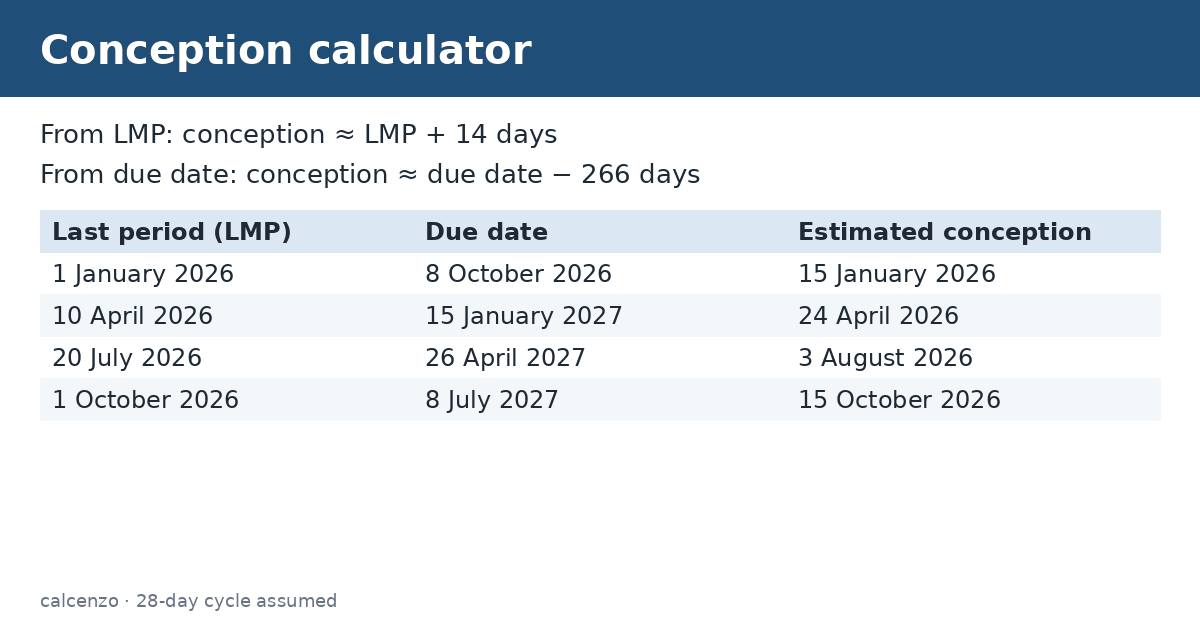
A conception calculator estimates the date you most likely conceived, working forward from your last period or back from your due date. Formula: LMP mode: conception = LMP + 14 days. Due mode: conception = due date − 266 days. If your last period began on 1 January 2026, or your due date is 8 October 2026, the estimated conception date is 15 January 2026.
On this page
How to use the conception calculator
- Choose whether you know the first day of your last period or your due date.
- Enter that date.
- Read the estimated conception date.
- If your cycle is not 28 days, adjust the result using the table below.
What is the conception formula?
- From your last period: conception ≈ first day of last menstrual period (LMP) + 14 days
- From a due date: conception ≈ due date − 266 days (38 weeks)
- Both assume a 28-day cycle with ovulation around day 14
The two methods agree because a due date is LMP + 280 days, and 280 − 266 = 14.
Conception calculator worked example
| Known date | Method | Estimated conception |
|---|---|---|
| 1 January 2026 (LMP) | + 14 days | 15 January 2026 |
| 10 April 2026 (LMP) | + 14 days | 24 April 2026 |
| 20 July 2026 (LMP) | + 14 days | 3 August 2026 |
| 8 October 2026 (due date) | − 266 days | 15 January 2026 |
| 15 January 2027 (due date) | − 266 days | 24 April 2026 |
The result is the most likely day, not a certainty. Conception could have happened a few days either side.
Why conception is a window, not a day
The NHS explains that in most women ovulation happens around 10 to 16 days before the next period, not always on day 14, and that sperm can survive in the fallopian tubes for up to 7 days after sex. So sex several days before ovulation can still lead to pregnancy, and two people with the same last-period date can conceive on different days. That is why the conception calculator date may not match the day you expect.
Adjusting for your cycle length
If your cycles are regular but not 28 days long, ovulation is roughly 14 days before your next period. For a 32-day cycle that is around day 18, so add about 18 days to the LMP instead of 14; for a 25-day cycle, add about 11. The tool always uses 14, so adjust its answer by hand.
| Cycle length | Likely ovulation day | Conception estimate from LMP |
|---|---|---|
| 24 days | Day 10 | LMP + 10 days |
| 26 days | Day 12 | LMP + 12 days |
| 28 days | Day 14 | LMP + 14 days |
| 30 days | Day 16 | LMP + 16 days |
| 32 days | Day 18 | LMP + 18 days |
| 35 days | Day 21 | LMP + 21 days |
The most accurate dating
An early ultrasound measures the baby and gives the most reliable gestational age; your clinician may change the due date after it, and the conception date moves with it. For IVF, the embryo transfer date fixes conception precisely, and clinics count the due date from it. Paternity questions cannot be settled by a conception date estimate, because of the uncertainty above.
For general information only, not medical advice. Your midwife, doctor or other clinician should confirm dates and care decisions.
How to use the conception estimate
People use a conception calculator for two main reasons: to plan when to try for a pregnancy, or to estimate when a pregnancy began. For planning, the useful part is the fertile window, the days before and on the day of ovulation. Having sex every one or two days during that window gives the best chance; there is no need to time it to a single day.
For estimating when a pregnancy began, remember that the conception calculator works backward from a due date or the first day of the last period, using an average cycle. It cannot pinpoint the day of conception, which can only be narrowed to a range of several days. A first-trimester ultrasound gives the most accurate dating, and your provider will use that rather than the conception calculator if they differ.
Signs of ovulation
Some people track ovulation directly rather than relying on calendar estimates. Ovulation predictor kits detect the surge in luteinizing hormone that happens a day or two before ovulation. Changes in cervical mucus, which becomes clearer and more slippery, and a small rise in resting body temperature after ovulation are other signs. Combining them gives a better picture than an average cycle length.
Related converters and calculators
Related calculators:
- Due date calculator: due date
- Ovulation calculator: fertile days
- Period calculator: cycle
- Pregnancy calculator: weeks
Sources
NHS: Periods and fertility in the menstrual cycle; NHS: Pregnancy due date calculator; ACOG Committee Opinion 700.
Questions about this calculator
How do I work out when I conceived?
Add about 14 days to the first day of your last period, or subtract 266 days from your due date.
How accurate is a conception date?
It is an estimate; ovulation timing and sperm survival make it a window of several days.
How long can sperm survive?
Up to 7 days in the fallopian tubes after sex, according to the NHS.
What if my cycle is longer than 28 days?
Ovulation is about 14 days before your next period, so it happens later.
Can a conception date prove paternity?
No. The uncertainty is too large; a DNA test is needed.
Check the assumptions and units before relying on a result. Financial, tax and health estimates do not replace advice for your individual circumstances.
Report a calculation issue