
A pregnancy calculator estimates your due date and approximate conception date from the first day of your last period and your cycle length. Formula: Due = LMP + 280 + (cycle – 28) days. Conception approx = LMP + 14 + (cycle – 28) days. An LMP of 1 January 2026 in a 28-day cycle gives a due date of 8 October 2026.
On this page
How to use the pregnancy calculator
- Enter the first day of your last period.
- Enter your average cycle length in days (20 to 45).
- Read the estimated due date and conception date.
How the pregnancy calculator works
The pregnancy calculator uses Naegele’s rule, the standard dating method based on the first day of the last menstrual period (LMP). A pregnancy is counted as 280 days, or 40 weeks, from the LMP in a 28-day cycle. The tool adjusts for other cycle lengths by adding or subtracting the difference from 28 days:
- Due date = LMP + 280 days + (cycle length − 28)
- Approximate conception = LMP + 14 days + (cycle length − 28)
The cycle box defaults to 28 days and accepts whole numbers from 20 to 45 days; other values are rejected with a message. The adjustment assumes ovulation happens about 14 days before the next period.
Pregnancy calculator worked example
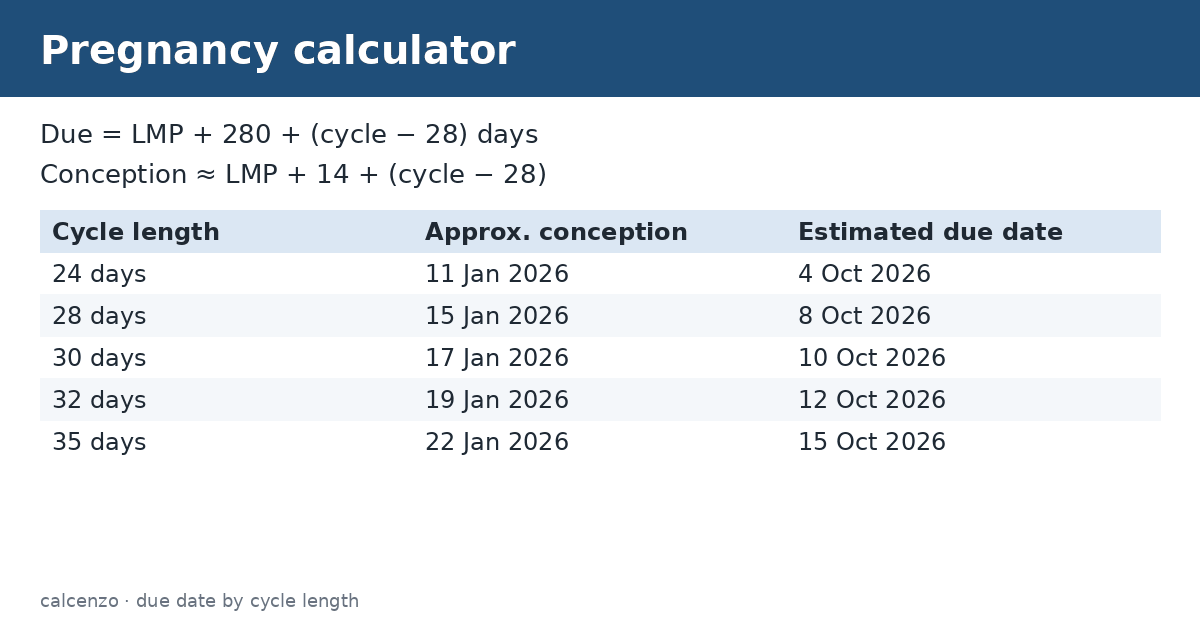
If the last period started on 1 January 2026 and cycles are 28 days, the pregnancy calculator gives a due date of 8 October 2026 and an approximate conception date of 15 January 2026. With a 32-day cycle, both dates move four days later, to 12 October and 19 January. The table shows the effect of cycle length for the same LMP.
| Cycle length | Approx. conception | Estimated due date |
|---|---|---|
| 24 days | 11 Jan 2026 | 4 Oct 2026 |
| 28 days | 15 Jan 2026 | 8 Oct 2026 |
| 30 days | 17 Jan 2026 | 10 Oct 2026 |
| 32 days | 19 Jan 2026 | 12 Oct 2026 |
| 35 days | 22 Jan 2026 | 15 Oct 2026 |
Counting weeks of pregnancy
Pregnancy weeks are counted from the LMP, not from conception, so at conception you are already about two weeks pregnant by this convention. To find how far along you are today, count the days since the LMP and divide by 7. Forty-five days after the LMP is 6 weeks and 3 days. The first trimester runs to the end of week 13, the second from week 14 to week 27, and the third from week 28 to birth.
Why an ultrasound may change the date
ACOG notes that ultrasound measurement in the first trimester, especially the crown-rump length up to about 13 weeks and 6 days, is the most accurate way to date a pregnancy. If the ultrasound date differs from the LMP date by more than a set amount, which depends on how far along the pregnancy is, the clinician changes the due date to match the scan. After IVF, the due date comes from the embryo transfer date instead. So the pregnancy calculator gives a starting estimate, and your care team sets the official date.
How exact is a due date?
Only a small share of babies arrive on the due date itself. A term pregnancy covers a range: ACOG describes 39 weeks 0 days to 40 weeks 6 days as full term, with early term and late term on either side. Treat the date as the middle of a window of a few weeks. The estimate is less reliable if you do not remember the LMP, if cycles are irregular, or if you became pregnant soon after stopping hormonal contraception or while breastfeeding.
Next steps after a positive test
Book a first prenatal visit with a doctor, midwife or clinic. Start a daily prenatal vitamin with folic acid if you have not already, and ask about medicines you take. Bring the LMP date and cycle length, the same inputs the pregnancy calculator uses, so the clinician can compare them with an early scan. Seek care urgently for heavy bleeding, severe one-sided pain or fainting.
Tips
- Enter the first day of full bleeding, not spotting.
- Use your average cycle length over several months; enter it as a whole number of days.
- Keep the result as a guide until a dating scan confirms it.
- Run the pregnancy calculator again if your clinician gives you a revised LMP or cycle length.
For general information only, not medical advice. Your midwife, doctor or other clinician should confirm dates and care decisions.
Related converters and calculators
Related calculators:
- Pregnancy due date calculator: due date methods
- Conception calculator: conception date
- Pregnancy weight gain calculator: weight gain by week
- Ovulation calculator: fertile window
The hCG doubling calculator works out how fast two hCG results rose. Talk to your doctor about what your numbers mean.
Sources
ACOG Committee Opinion 700: Methods for estimating the due date.
Formula and method
Due = LMP + 280 + (cycle - 28) days. Conception approx = LMP + 14 + (cycle - 28) days.
Naegele rule based estimate adjusted for cycle length versus 28 days. Not an ultrasound dating tool or medical diagnosis.
Questions about this calculator
How is the due date calculated?
LMP + 280 days, adjusted by your cycle length minus 28.
Is the due date exact?
No, it is the middle of a range of several weeks.
Why are weeks counted from the LMP?
It is the standard convention, because the LMP is usually known and conception is not.
Can an ultrasound change my due date?
Yes. An early scan is more accurate and may replace the LMP date.
What cycle lengths can I enter?
20 to 45 days.
Check the assumptions and units before relying on a result. Financial, tax and health estimates do not replace advice for your individual circumstances.
Report a calculation issue