
A due date calculator estimates when your baby is due by adding 280 days, or 40 weeks, to the first day of your last menstrual period. If your last period started on 1 January 2026, your estimated due date is 8 October 2026; a first-trimester ultrasound may adjust it.
On this page
How to use the due date calculator
- Enter the first day of your last menstrual period.
- Read your estimated due date.
- Check how many weeks and days have passed since your LMP.
- Compare it with the date from your dating scan when you have one.
Due date calculator formula and Naegele’s rule
- Due date = first day of your last menstrual period (LMP) + 280 days (40 weeks)
- Naegele’s rule gives the same date by hand: LMP + 7 days − 3 months + 1 year
- Weeks pregnant = days since the LMP ÷ 7
The method assumes a 28-day cycle with ovulation around day 14, which is why pregnancy is counted from the period, about two weeks before conception.
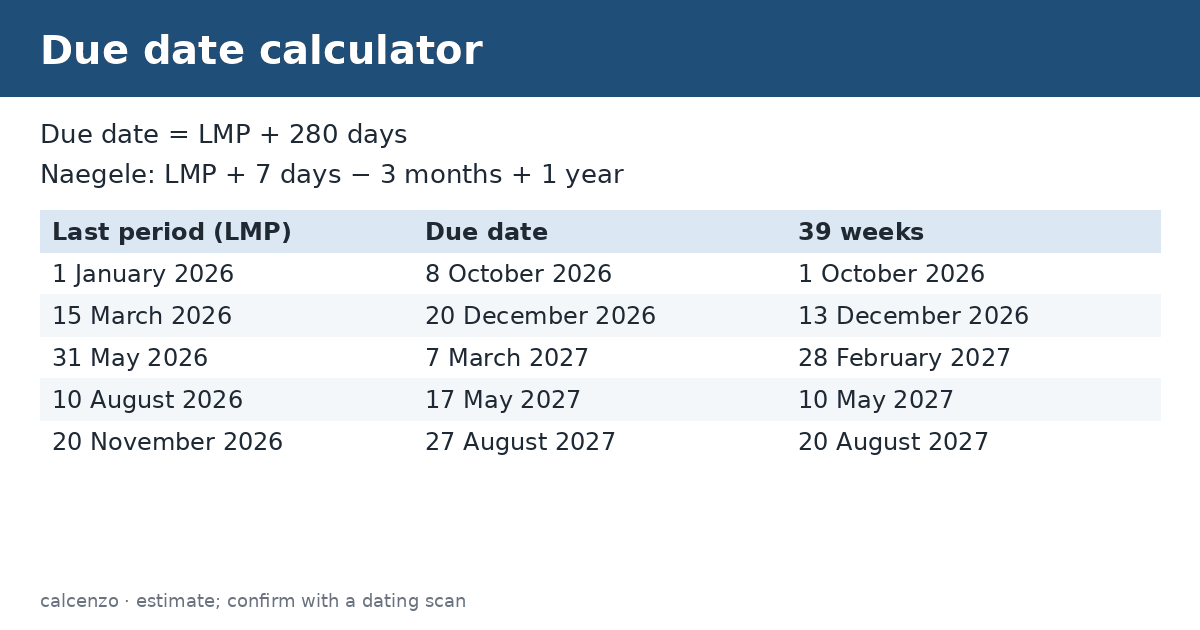
Due date calculator worked example
| First day of last period | + 280 days = due date | 39 weeks (full term begins) |
|---|---|---|
| 1 January 2026 | 8 October 2026 | 1 October 2026 |
| 15 March 2026 | 20 December 2026 | 13 December 2026 |
| 31 May 2026 | 7 March 2027 | 28 February 2027 |
| 10 August 2026 | 17 May 2027 | 10 May 2027 |
| 20 November 2026 | 27 August 2027 | 20 August 2027 |
With Naegele’s rule for 1 January 2026: add 7 days (8 January), subtract 3 months (8 October) and add a year, giving 8 October 2026, the same as adding 280 days.
How accurate is a due date?
A due date is an estimate, not a deadline; only a small share of babies arrive on that exact day. The American College of Obstetricians and Gynecologists (ACOG) says ultrasound in the first trimester is the most accurate way to set or confirm the due date. If an ultrasound before 9 weeks differs from the LMP date by more than 5 days, or by more than 7 days between 9 and 13 weeks and 6 days, the due date is normally changed to the ultrasound date.
Early, full, late and post-term
| Label (ACOG) | Gestational age |
|---|---|
| Early term | 37 weeks 0 days to 38 weeks 6 days |
| Full term | 39 weeks 0 days to 40 weeks 6 days |
| Late term | 41 weeks 0 days to 41 weeks 6 days |
| Post-term | 42 weeks 0 days and later |
When the LMP method is less reliable
- Cycles that are irregular or much longer or shorter than 28 days.
- Not knowing the date of the last period, or bleeding in early pregnancy.
- Recent use of hormonal contraception or breastfeeding.
- IVF pregnancies, where the transfer date gives a more precise due date.
In these cases treat the due date calculator result as a first estimate and rely on the date from your dating scan.
For general information only, not medical advice. Your midwife, doctor or other clinician should confirm dates and care decisions.
After your first scan
Many people get a dating ultrasound in the first trimester. If the scan date and the due date calculator result differ by more than a few days, your provider may change your due date to the one from the scan, since early ultrasound measurements are more accurate than the LMP method for many people. After that, the due date is not usually changed again on the basis of later scans.
The calculator also shows how far along you are today, in completed weeks and days. Pregnancy weeks are counted from the first day of the last period, so at the moment of conception you are already about two weeks pregnant by this count.
Planning around the date
Treat the date from the due date calculator as the middle of a window rather than a deadline. Only a small share of babies arrive on the exact day, and most are born within a couple of weeks either side. Plan leave from work, help at home and travel with some flexibility, and avoid long trips in the last weeks of pregnancy unless your provider agrees. Use the due date calculator again if your cycle was irregular or you are not sure of the date of your last period, and share the result with your provider at your first appointment so they can confirm it.
Related converters and calculators
Related calculators:
- Conception calculator: conception date
- Ovulation calculator: fertile days
- Pregnancy calculator: week by week
- Pregnancy weight gain calculator: weight
Sources
ACOG Committee Opinion 700: Methods for estimating the due date; NHS: Pregnancy due date calculator; ACOG Committee Opinion 579: Definition of term pregnancy.
Questions about this calculator
How is a due date calculated?
By adding 280 days (40 weeks) to the first day of your last menstrual period.
What is Naegele’s rule?
Add 7 days to the LMP, subtract 3 months and add a year.
Is the due date accurate?
It is an estimate; ACOG says first-trimester ultrasound is the most accurate dating method.
When is a baby full term?
From 39 weeks 0 days to 40 weeks 6 days.
What if my cycle is not 28 days?
The LMP estimate may be off; your scan date is usually used instead.
Check the assumptions and units before relying on a result. Financial, tax and health estimates do not replace advice for your individual circumstances.
Report a calculation issue