
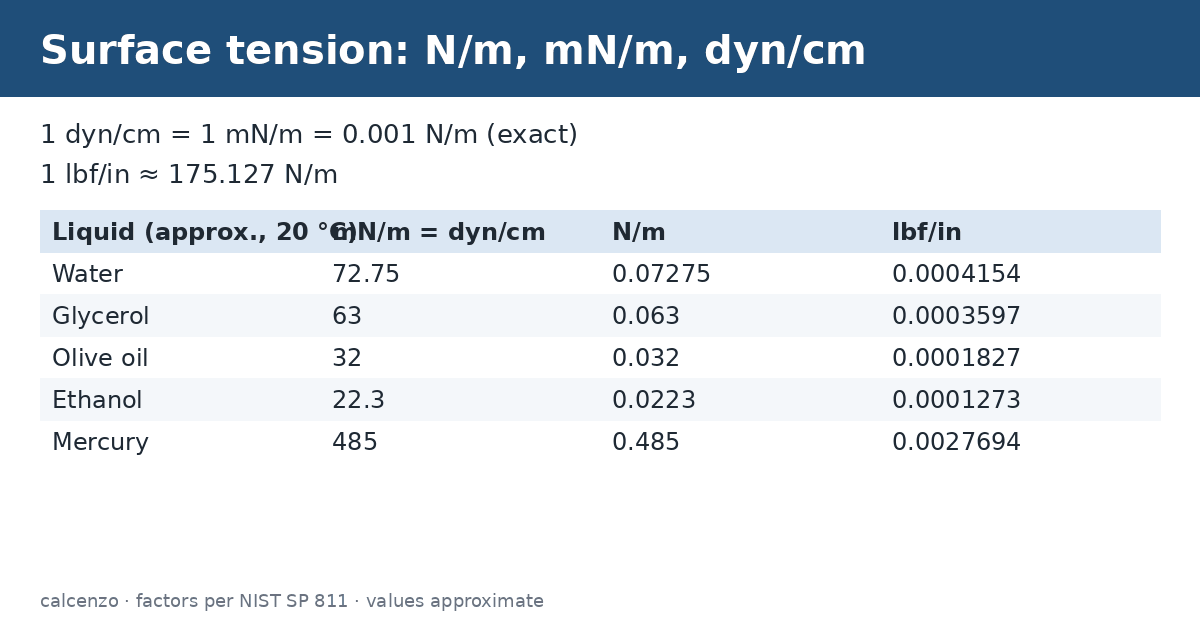
This surface tension converter changes a surface tension between newtons per meter, millinewtons per meter, dynes per centimeter, pound-force per inch and pound-force per foot. Formula: 1 dyn/cm = 1 mN/m = 0.001 N/m. The SI unit is N/m. 1 dyn/cm is exactly 1 mN/m (0.001 N/m), so lab values in the two units are the same number.
On this page
How to use the surface tension converter
- Enter the value, for example 72.75 from a reference table in mN/m.
- In the surface tension converter, choose its unit and the target unit.
- Read the surface tension converter result: 72.75 mN/m = 72.75 dyn/cm = 0.07275 N/m.
For dyne/cm to N/m, divide by 1,000.
What is surface tension?
Surface tension is the force per unit length along a liquid surface, in newtons per meter. Water at room temperature is about 72 mN/m, which equals 72 dyn/cm.
Conversion formula
The surface tension converter stores every unit as a multiple of the base unit, the newton per meter (N/m). To convert:
value in target unit = value × (factor of source unit ÷ factor of target unit)
where each factor is the size of the unit in newtons per meter.
Common surface tension conversions
| From | To | 1 unit equals |
|---|---|---|
| dyne per centimeter (dyn/cm) | newton per meter (N/m) | 0.001 N/m |
| millinewton per meter (mN/m) | dyne per centimeter (dyn/cm) | 1 dyn/cm |
| newton per meter (N/m) | pound-force per inch (lbf/in) | 0.005710147 lbf/in |
Surface tension converter worked example
Convert 25 millinewtons per meter to dynes per centimeter:
- Factor of mN/m = 0.001 N/m
- Factor of dyn/cm = 0.001 N/m
- 25 × 0.001 ÷ 0.001 = 25 dyn/cm
Surface tension unit reference
| Unit | Symbol | Group | Equals (N/m) |
|---|---|---|---|
| Newton per Meter | N/m | SI | 1 |
| Millinewton per Meter | mN/m | SI | 0.001 |
| Dyne per Centimeter | dyn/cm | CGS | 0.001 |
| Pound-Force per Inch | lbf/in | US/Imperial | 175.1268352 |
| Pound-Force per Foot | lbf/ft | US/Imperial | 14.59390294 |
Reverse factors for each surface tension unit
The reference table gives each unit in newton per meters. To go the other way, divide by that factor; the list below does the division for you.
- Millinewton per Meter (mN/m), SI: 1 mN/m = 0.001 N/m, so 1 N/m = 1,000 mN/m.
- Dyne per Centimeter (dyn/cm), CGS: 1 dyn/cm = 0.001 N/m, so 1 N/m = 1,000 dyn/cm.
- Pound-Force per Inch (lbf/in), US/Imperial: 1 lbf/in = 175.1268 N/m, so 1 N/m = 0.005710147 lbf/in.
- Pound-Force per Foot (lbf/ft), US/Imperial: 1 lbf/ft = 14.5939 N/m, so 1 N/m = 0.06852177 lbf/ft.
Surface tension of common liquids
Approximate values in air near 20 °C; the water value is from the IAPWS release on surface tension:
| Liquid (approximate, 20 °C) | mN/m = dyn/cm | N/m |
|---|---|---|
| Water | 72.75 | 0.07275 |
| Glycerol | 63 | 0.063 |
| Olive oil | 32 | 0.032 |
| Ethanol | 22.3 | 0.0223 |
| Mercury | 485 | 0.485 |
Surface tension falls as temperature rises and drops sharply with soaps and surfactants.
Capillary rise shows why the value matters: a liquid climbs h = 2γ cos θ ÷ (ρ g r) in a narrow tube. For water (γ = 0.07275 N/m, ρ ≈ 998 kg/m³) in a clean glass tube of 0.5 mm radius, where θ ≈ 0, the rise is about 29.7 mm. Halving the radius doubles the rise.
Why surface tension units are force per length
Surface tension is force per unit length along the surface, or equivalently energy per unit area: 1 N/m = 1 J/m². That is why mJ/m² appears in surface science papers. For dyn/cm to mN/m, the number stays the same. Related fluid properties are in the dynamic viscosity converter.
Capillary rise
Surface tension explains why water climbs a narrow tube. The height is h = 2γ cos θ ÷ (ρ g r). For clean water at 20 °C, γ is about 72.8 mN/m and the contact angle with clean glass is close to zero. In a tube with a 0.5 mm radius, h = 2 × 0.0728 ÷ (1,000 × 9.81 × 0.0005) ≈ 0.030 m, or about 30 mm.
Use N/m in the formula. The surface tension converter changes mN/m or dyn/cm, which are numerically the same, to N/m by dividing by 1,000. Adding soap lowers water to around 30 mN/m, so capillary rise and droplet size both fall.
Temperature matters as well: water falls to about 60.8 mN/m at 90 °C, so hot water wets surfaces more easily and cleans better.
Related converters and calculators
Related fluid tools:
- Viscosity converter: cP and Pa·s
- Kinematic viscosity converter: cSt and mm²/s
- Density converter: kg/m³ and g/cm³
- Force converter: N and lbf
Sources
NIST Special Publication 811, Appendix B; IAPWS: Surface tension of ordinary water substance.
Questions about this calculator
What is the SI unit of surface tension?
Newton per meter (N/m), equal to J/m².
Is dyn/cm the same as mN/m?
Yes, exactly: 1 dyn/cm = 1 mN/m.
How do I convert dyne/cm to N/m?
Divide by 1,000. For example, 72 dyn/cm = 0.072 N/m.
What is the surface tension of water?
About 72.75 mN/m at 20 °C.
How do I convert N/m to lbf/in?
Divide by 175.127. For example, 0.072 N/m ≈ 0.000411 lbf/in.
Check the assumptions and units before relying on a result. Financial, tax and health estimates do not replace advice for your individual circumstances.
Report a calculation issue