
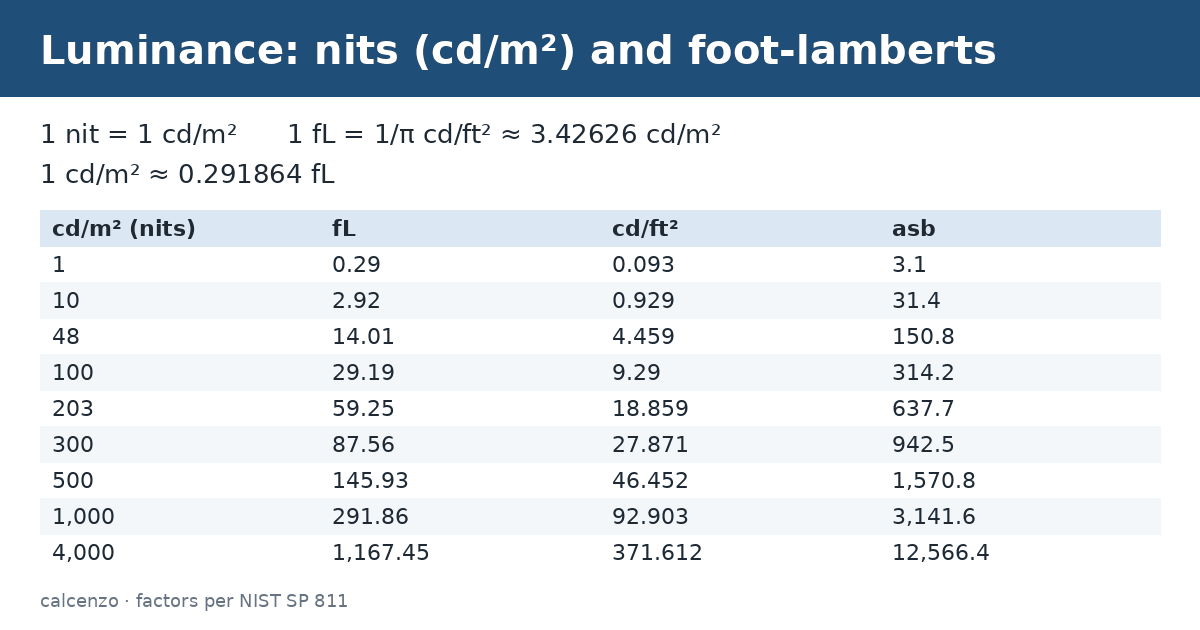
This luminance converter changes surface brightness between candelas per square meter (nits), stilbs, apostilbs, foot-lamberts, lamberts and candelas per square foot. The luminance converter uses this formula: 1 nit = 1 cd/m²; 1 foot-lambert ≈ 3.4262591 cd/m². One nit is exactly 1 cd/m², so cd/m² to nits needs no arithmetic, and 1 foot-lambert is 1/π cd/ft², about 3.42626 cd/m².
On this page
How to use the luminance converter
- Enter the brightness, for example 48 from a cinema projector setup in cd/m².
- In the luminance converter, choose its unit and the target unit, such as nits to foot-lamberts.
- Read the result: 48 nits ≈ 14.0 fL.
For nits to foot-lamberts, divide by 3.42626 (or multiply by 0.291864). For foot-lamberts to nits, multiply by 3.42626.
What is luminance?
Luminance is the brightness of a light-emitting or reflecting surface in a given direction, in candelas per square meter (cd/m²), also called nits. Screen brightness is usually specified in nits.
Conversion formula
Every unit is stored as a multiple of the base unit, the candela per square meter (cd/m²). To convert:
value in target unit = value × (factor of source unit ÷ factor of target unit)
where each factor is the size of the unit in candelas per square meter.
Common luminance conversions
| From | To | 1 unit equals |
|---|---|---|
| candela per square meter (cd/m²) | nit (nt) | 1 nt |
| nit (nt) | foot-lambert (fL) | 0.2918635 fL |
| foot-lambert (fL) | candela per square meter (cd/m²) | 3.426259 cd/m² |
| stilb (sb) | candela per square meter (cd/m²) | 10,000 cd/m² |
| lambert (L) | nit (nt) | 3,183.099 nt |
Luminance converter worked example
Convert 25 nits to foot-lamberts:
- Factor of nt = 1 cd/m²
- Factor of fL = 3.4262591 cd/m²
- 25 × 1 ÷ 3.4262591 = 7.296588 fL
Luminance unit reference
| Unit | Symbol | Group | Equals (cd/m²) |
|---|---|---|---|
| Candela per Square Meter | cd/m² | SI | 1 |
| Nit | nt | SI | 1 |
| Stilb | sb | CGS | 10,000 |
| Apostilb | asb | Other | 0.3183098862 |
| Foot-Lambert | fL | US/Imperial | 3.4262591 |
| Lambert | L | CGS | 3,183.098862 |
| Candela per Square Foot | cd/ft² | US/Imperial | 10.76391042 |
Reverse factors for each luminance unit
The reference table gives each unit in candela per square meters. To go the other way, divide by that factor; the list below does the division for you.
- Nit (nt), SI: 1 nt = 1 cd/m², so 1 cd/m² = 1 nt.
- Stilb (sb), CGS: 1 sb = 10,000 cd/m², so 1 cd/m² = 0.0001 sb.
- Apostilb (asb), Other: 1 asb = 0.3183099 cd/m², so 1 cd/m² = 3.141593 asb.
- Foot-Lambert (fL), US/Imperial: 1 fL = 3.426259 cd/m², so 1 cd/m² = 0.2918635 fL.
- Lambert (L), CGS: 1 L = 3,183.099 cd/m², so 1 cd/m² = 0.0003141593 L.
- Candela per Square Foot (cd/ft²), US/Imperial: 1 cd/ft² = 10.76391 cd/m², so 1 cd/m² = 0.09290304 cd/ft².
Display and cinema luminance levels
Display and projection standards state their brightness targets in cd/m², while older US cinema practice uses foot-lamberts. The SMPTE reference for digital cinema is 48 cd/m², the familiar 14 fL. Video standards set much higher levels for HDR:
| Example | cd/m² (nits) | foot-lamberts |
|---|---|---|
| DCI cinema screen, SMPTE reference | 48 | 14 |
| SDR video reference white (ITU-R BT.2408 uses 203 for HDR graphics white) | 100 | 29.2 |
| HDR graphics white, ITU-R BT.2408 | 203 | 59.2 |
| HDR10 mastering display, common target | 1,000 | 291.9 |
| PQ signal ceiling, SMPTE ST 2084 | 10,000 | 2,918.6 |
The 10,000 cd/m² row is the top of the PQ encoding curve, not a typical display; consumer HDR panels usually peak far lower. A phone or monitor specification in nits uses exactly the same unit as cd/m².
Luminance, illuminance and luminous intensity
Three related photometric quantities are easy to confuse. Luminous intensity (candela) is light emitted in one direction from a source. Illuminance (lux) is light arriving on a surface. Luminance (cd/m²) is how bright a surface looks: intensity per unit of projected area. For a perfectly diffusing white surface, luminance in cd/m² equals illuminance in lux × reflectance ÷ π. For example, a white page with 80% reflectance under 500 lux has a luminance of about 127 cd/m², or 37 fL. Use the illuminance converter for lux and foot-candles and the luminous intensity converter for candelas.
Screens outdoors
Phone and laptop specs list brightness in nits, which are cd/m². A phone that peaks at 1,500 nits outdoors puts out about 438 fL in the luminance converter, against about 14 fL (48 nits) for a standard cinema screen. That gap is why a screen tuned for a dark room looks washed out in daylight.
HDR content is graded in nits as well, so a 1,000-nit master is about 292 fL. Projector reviews often quote foot-lamberts while TV reviews quote nits, and a luminance converter puts both on one scale. Run the luminance converter on a 3,000-nit outdoor sign and you get about 876 fL.
Related converters and calculators
Related light tools:
- Illuminance converter: lux and fc
- Luminous intensity converter: cd and mcd
- Image resolution converter: dpi and ppi
- Area converter: m² and ft²
- Frequency to wavelength converter: Hz to m
Sources
NIST Special Publication 811, Appendix B; ITU-R BT.2408: Guidance for operational practices in HDR television production.
Questions about this calculator
Is a nit the same as cd/m²?
Yes. 1 nit = 1 candela per square meter exactly.
How do I convert nits to foot-lamberts?
Divide by 3.42626. For example, 100 nits ≈ 29.2 fL.
How do I convert foot-lamberts to nits?
Multiply by 3.42626. For example, 14 fL ≈ 48 nits.
What is a foot-lambert?
A non-SI luminance unit equal to 1/π candela per square foot, about 3.42626 cd/m².
What is an apostilb?
1/π cd/m², about 0.3183 cd/m²; 1 lambert is 10,000 apostilbs.
How bright is a cinema screen?
The SMPTE digital cinema reference is 48 cd/m², about 14 foot-lamberts.
Check the assumptions and units before relying on a result. Financial, tax and health estimates do not replace advice for your individual circumstances.
Report a calculation issue