
This luminous intensity unit converter changes light output in one direction between candelas, kilocandelas, millicandelas and three historic units: the international candle, the Hefner candle and the violle. The candela is one of the seven SI base units, so cd, kcd and mcd convert by exact powers of ten: 1 cd = 1,000 mcd.
On this page
How to use the luminous intensity unit converter
- Enter the value, for example 2,500 from an LED datasheet in mcd.
- In the luminous intensity unit converter, choose its unit and the target unit, such as mcd to candela.
- Read the luminous intensity unit converter result: 2,500 mcd = 2.5 cd.
For mcd to candela, divide by 1,000; for candela to mcd, multiply by 1,000. The historic candle units use approximate factors and are given for old literature only.
What is luminous intensity?
Luminous intensity is the light output of a source in a particular direction. Its SI unit, the candela (cd), is one of the seven SI base units; historic units such as the international candle and Hefner candle appear in older literature.
Conversion formula
The luminous intensity unit converter stores every unit as a multiple of the base unit, the candela (cd). To convert:
value in target unit = value × (factor of source unit ÷ factor of target unit)
where each factor is the size of the unit in candelas.
Common luminous intensity conversions
| From | To | 1 unit equals |
|---|---|---|
| candela (cd) | millicandela (mcd) | 1,000 mcd |
| millicandela (mcd) | candela (cd) | 0.001 cd |
| candela (cd) | international candle (c) | 0.9803922 c |
| kilocandela (kcd) | candela (cd) | 1,000 cd |
Luminous intensity unit converter worked example
Convert 25 candelas to millicandelas:
- Factor of cd = 1 cd
- Factor of mcd = 0.001 cd
- 25 × 1 ÷ 0.001 = 25,000 mcd
Luminous intensity unit reference
| Unit | Symbol | Group | Equals (cd) |
|---|---|---|---|
| Candela | cd | SI | 1 |
| Kilocandela | kcd | SI | 1,000 |
| Millicandela | mcd | SI | 0.001 |
| International Candle | c | Historical | 1.02 |
| Hefnerkerze | HK | Historical | 0.92 |
| Violle | V | Historical | 20.17 |
Reverse factors for each luminous intensity unit
The luminous intensity unit converter reference table gives each unit in candelas. To go the other way, divide by that factor; the list below does the division for you.
- Kilocandela (kcd), SI: 1 kcd = 1,000 cd, so 1 cd = 0.001 kcd.
- Millicandela (mcd), SI: 1 mcd = 0.001 cd, so 1 cd = 1,000 mcd.
- International Candle (c), Historical: 1 c = 1.02 cd, so 1 cd = 0.9803922 c.
- Hefnerkerze (HK), Historical: 1 HK = 0.92 cd, so 1 cd = 1.086957 HK.
- Violle (V), Historical: 1 V = 20.17 cd, so 1 cd = 0.04957858 V.
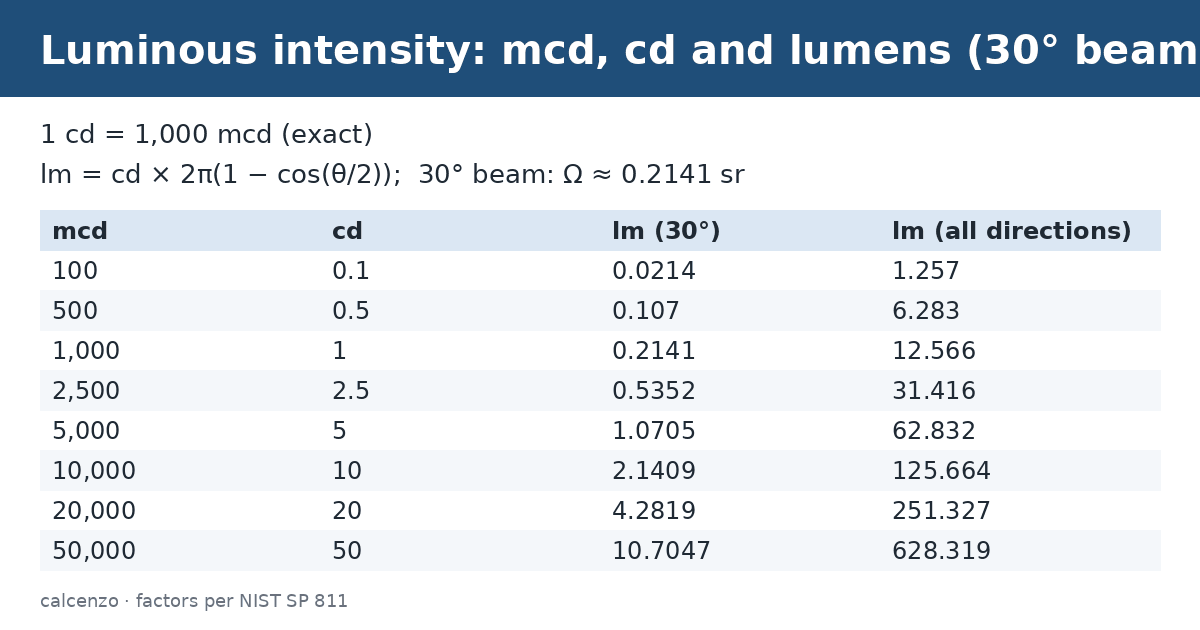
Converting mcd to lumens
Candelas and lumens measure different things, so mcd to lumens needs the beam angle. Luminous flux equals intensity times solid angle: Φ (lm) = I (cd) × Ω (sr). For a cone with full beam angle θ, Ω = 2π(1 − cos(θ/2)). Assuming uniform intensity across the beam:
| Beam angle | Solid angle (sr) | 1,000 mcd LED (lm) |
|---|---|---|
| 15° | 0.0538 | 0.0538 |
| 30° | 0.2141 | 0.2141 |
| 60° | 0.8418 | 0.8418 |
| 90° | 1.8403 | 1.8403 |
| 120° | 3.1416 | 3.1416 |
A 1,000 mcd (1 cd) LED with a 30° beam therefore gives about 0.21 lm. Real LEDs are brighter in the center than at the edge, so this is an estimate; the datasheet flux value is better when available. A source shining equally in all directions has Ω = 4π, so 1 cd corresponds to about 12.57 lm.
How the candela is defined
The SI defines the candela by fixing the luminous efficacy of 540 × 10¹² Hz monochromatic radiation at exactly 683 lm/W. In practice, a source emitting 1/683 W per steradian of green light at that frequency has an intensity of 1 cd. A common wax candle is roughly 1 cd, which is where the unit’s name comes from. Use the luminance converter when intensity is spread over a surface and the illuminance converter for light falling on a surface.
Beam distance from candela
Flashlight packaging uses peak beam intensity in candela. The ANSI FL1 standard defines beam distance as the distance where the light falls to 0.25 lux, which works out to 2 × √cd meters. A 10,000 cd light has a rated beam distance of 200 m. The luminous intensity unit converter helps when a spec gives candlepower or millicandela instead.
Related converters and calculators
Related light tools:
- Luminance converter: nits and fL
- Illuminance converter: lux and fc
- Image resolution converter: dpi and ppi
- Power unit converter: W and BTU/h
- Frequency to wavelength converter: Hz to m
Sources
BIPM: SI Brochure; NIST Special Publication 811, Appendix B.
Questions about this calculator
How many mcd are in a candela?
1,000 mcd = 1 cd exactly.
How do I convert mcd to candela?
Divide by 1,000. For example, 8,000 mcd = 8 cd.
Can I convert mcd to lumens?
Only with the beam angle: lm = cd × 2π(1 − cos(θ/2)). 1 cd over a 60° beam is about 0.84 lm.
How many lumens is 1 candela in all directions?
4π lm, about 12.57 lm, for a uniform point source.
Is the candela an SI base unit?
Yes, one of the seven, defined through a luminous efficacy of exactly 683 lm/W at 540 THz.
Check the assumptions and units before relying on a result. Financial, tax and health estimates do not replace advice for your individual circumstances.
Report a calculation issue