
A points-style food calculator turns calories, fat and fiber into a single score using the classic public formula. A 250-calorie bar with 8 g of fat and 3 g of fiber scores about 5.1 points.
On this page
How to use the points-style food calculator
- Enter calories per serving.
- Enter fat in grams.
- Enter fiber in grams.
- Read the estimated points.
How the points-style food calculator works
This points-style food calculator uses the classic, publicly described formula for food points from the late 1990s: points = calories ÷ 50 + fat in grams ÷ 12 − fiber in grams ÷ 5. Fiber credit is capped at 4 grams, so fiber can reduce the total by at most 0.8. The result is never less than zero and is shown to one decimal place. It is an educational estimate and is not the current formula of any commercial program.
Not an official program tool
Commercial weight-loss programs have changed their systems several times, moving from the classic formula to PointsPlus, SmartPoints and later systems that weigh protein, sugar and saturated fat. Their current formulas are proprietary. The points-style food calculator is not affiliated with or endorsed by any program, and its numbers will not match an app or a printed guide from one. If you follow a paid plan, use its own tools.
Points-style food calculator worked example
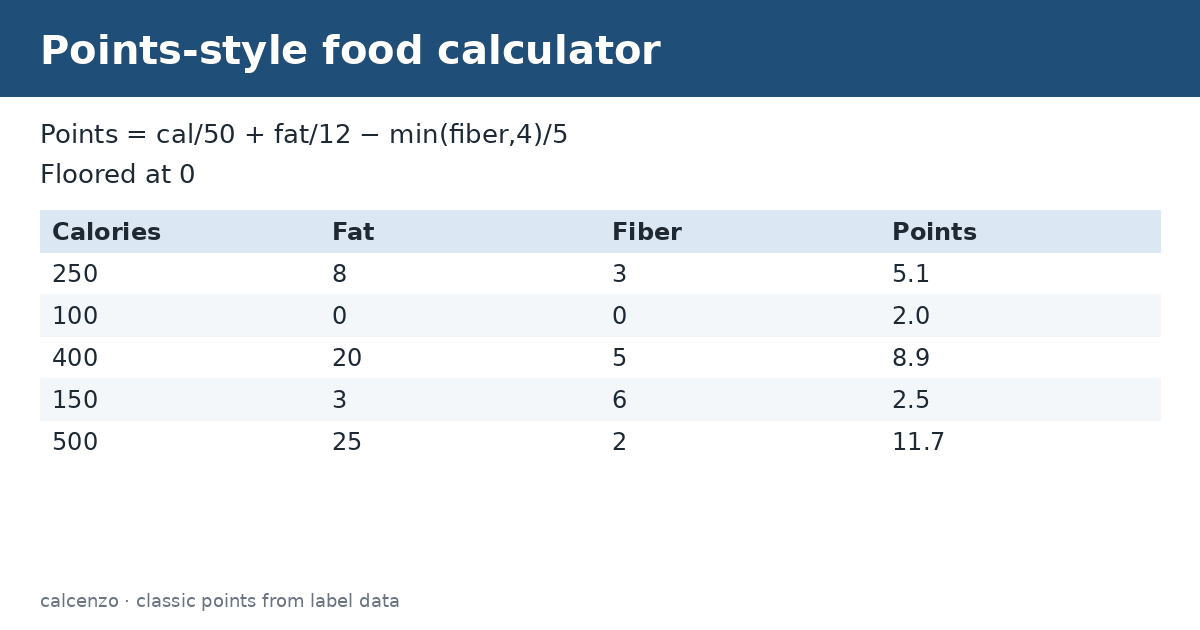
A snack bar with 250 calories, 8 grams of fat and 3 grams of fiber scores 250 ÷ 50 + 8 ÷ 12 − 3 ÷ 5 = 5 + 0.67 − 0.6 = 5.1 points. A 400-calorie meal with 20 grams of fat and 5 grams of fiber scores 8 + 1.67 − 0.8 = 8.9, because only 4 grams of fiber count. The table shows more foods.
| Calories | Fat (g) | Fiber (g) | Points |
|---|---|---|---|
| 250 | 8 | 3 | 5.1 |
| 100 | 0 | 0 | 2.0 |
| 400 | 20 | 5 | 8.9 |
| 150 | 3 | 6 | 2.5 |
| 500 | 25 | 2 | 11.7 |
Reading the Nutrition Facts label
Take calories, total fat and dietary fiber from the Nutrition Facts label. All values on the label are per serving, and the serving size is listed at the top. If you eat two servings, double each number before you enter it, or double the result. The label also lists saturated fat, sodium, added sugars and protein, which matter for health even though this formula ignores them.
Why fat and fiber are in the formula
Fat has about 9 calories per gram, compared with about 4 for protein and carbohydrate, so the extra fat term nudges choices toward lower-fat foods. Fiber adds bulk and helps you feel full, so it earns a small credit. The weighting is simple, which made the system easy to use by hand, but it treats all fats alike and gives no credit for protein.
Limits of a points estimate
Points summarize energy in a single number but say little about nutrition quality. Two foods with the same score can differ widely in protein, vitamins and minerals. Calorie needs also vary with size, age, sex and activity. Use the points-style food calculator to compare similar foods, and use a calorie or TDEE estimate to set an overall budget. People with diabetes, kidney disease or other conditions should follow advice from their clinician or a registered dietitian.
Comparing foods with the points-style food calculator
Scores are most useful when you compare similar choices. Two breakfast cereals, two yogurts or two sandwich fillings can be scored from their labels in a minute, and the lower score usually means fewer calories or less fat per serving. Check that the serving sizes match before comparing, because a smaller serving can make a food look better than it is.
Tips
- Enter values per serving actually eaten.
- Compare similar foods rather than very different ones.
- Watch protein and fiber, not only the score.
- Use the result as a rough guide.
For general information only, not medical advice. Your midwife, doctor or other clinician should confirm dates and care decisions.
Related converters and calculators
Related calculators:
- Calorie calculator: daily calories
- TDEE calculator: energy needs
- Fat intake calculator: fat
- Macro calculator: macros
Sources
FDA: How to understand and use the Nutrition Facts label; FDA: Daily Value on the Nutrition and Supplement Facts labels.
Questions about this calculator
What formula does it use?
Calories ÷ 50 + fat ÷ 12 − fiber ÷ 5, with fiber capped at 4 g.
Is it the current official formula?
No, it is a classic educational estimate.
Why is fiber capped?
The classic formula limits the fiber credit to 4 g.
Can the result be negative?
No, it is floored at zero.
Where do I get the numbers?
From the Nutrition Facts label, per serving.
Check the assumptions and units before relying on a result. Financial, tax and health estimates do not replace advice for your individual circumstances.
Report a calculation issue