
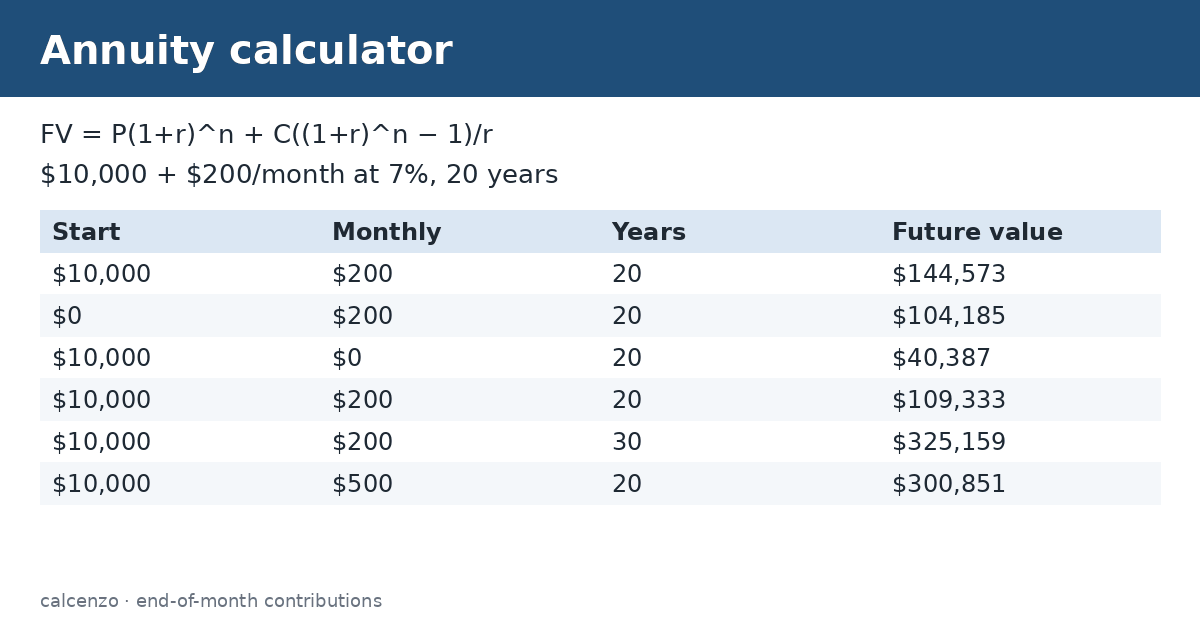
An annuity calculator works out what a starting amount and a series of equal monthly contributions will grow to at a fixed rate of return. $10,000 plus $200 a month at 7% for 20 years grows to about $144,573, from $58,000 paid in.
On this page
How to use the annuity calculator
- Enter the starting amount, or 0.
- Enter the monthly contribution.
- Enter the expected annual return.
- Enter the number of years.
- Read the future value, total contributions and growth.
What formula does the annuity calculator use?
- Monthly rate r = annual rate ÷ 12; number of months n = years × 12
- Growth of the starting amount = P × (1 + r)n
- Future value of the monthly contributions = C × ((1 + r)n − 1) ÷ r
- Future value = the two added together
This is the future value of an ordinary annuity: contributions are made at the end of each month and returns compound monthly. If you contribute at the start of each month (an annuity due), multiply the contribution part by (1 + r).
Annuity calculator worked example
| Start | Monthly | Return | Years | Paid in | Future value |
|---|---|---|---|---|---|
| $10,000 | $200 | 7% | 20 | $58,000 | $144,573 |
| $0 | $200 | 7% | 20 | $48,000 | $104,185 |
| $10,000 | $0 | 7% | 20 | $10,000 | $40,387 |
| $10,000 | $200 | 5% | 20 | $58,000 | $109,333 |
| $10,000 | $200 | 7% | 30 | $82,000 | $325,159 |
| $10,000 | $500 | 7% | 20 | $130,000 | $300,851 |
Starting with $10,000 and adding $200 a month at 7% for 20 years, you pay in $58,000 and end with about $144,573. The starting $10,000 grows to about $40,387 on its own; the monthly contributions grow to about $104,185.
Two meanings of “annuity”
In finance maths, an annuity is any series of equal payments at regular intervals, and this annuity calculator works out what such a series grows to. In everyday use, an annuity is also an insurance contract: you pay an insurer a lump sum or a series of payments, and it pays you an income later, often for life. The SEC notes that annuities can be fixed, variable or indexed, and that they often carry fees and surrender charges if you withdraw early. The calculator does not model any particular product, its fees or its guarantees.
Choosing a return rate
The rate you enter has a large effect over long periods. In the table, cutting the return from 7% to 5% reduces the 20-year value by about $35,240. Use a rate that matches the investment: a fixed annuity or savings account pays a stated rate, while stock-based investments vary from year to year and can fall. Fees reduce your return directly, so subtract them from the rate you enter.
Taxes and inflation
The result is in future dollars before tax. Growth inside many annuity contracts and retirement accounts is tax-deferred, but withdrawals may be taxed as income, and early withdrawals can bring penalties. To see the value in today’s money, divide the result by (1 + inflation rate)years; at 3% inflation over 20 years, divide by about 1.81.
Estimates for education only, not financial advice. Your lender’s figures are final.
Why regular contributions matter
In the example, the monthly contributions end up larger than the starting amount, even though each one is small. Over 20 years, 240 payments of $200 add up to $48,000 of your own money, and each payment has time to grow. Starting earlier has an even bigger effect than contributing more: in the annuity calculator, adding ten years to the term raises the future value far more than a modest increase in the monthly amount.
If your contributions will rise over time, for example with pay increases, run the annuity calculator in stages: work out the value at the point the contribution changes, then use that as the starting amount for the next stage with the new monthly figure.
From saving to income
The future value is the amount available when saving stops. To see what income it could provide, use an annuity payout calculator, which works the other way: it takes a lump sum, a rate and a number of years and gives the monthly payment that would use the money up over that time.
Related converters and calculators
Related calculators:
- Annuity payout calculator: income
- Future value calculator: future value
- Compound interest calculator: compounding
- Retirement calculator: retirement
Sources
Investor.gov (SEC): Annuities; Investor.gov (SEC): Compound interest calculator.
Accumulation versus payout
Accumulation asks how a balance grows with contributions and interest. Payout asks how long a balance lasts or what payment it can support. Use this annuity calculator for growth-style questions, then open the annuity payout calculator for payment-versus-duration modes with monthly, quarterly, or annual frequency.
Annuity payment vs annuity payout
Payment usually means the recurring amount during the payout phase. Payout can also mean the plan that empties a lump sum over time. Match the tool to the question: growing a nest egg versus drawing it down.
Questions about this calculator
How do I calculate the future value of an annuity?
FV = P(1 + r)^n + C((1 + r)^n − 1) ÷ r, with monthly r and n.
What does $200 a month at 7% grow to in 20 years?
With a $10,000 start, about $144,573.
Are contributions at the start or end of the month?
The end (ordinary annuity); multiply the contribution part by (1 + r) for the start.
Does it include fees or taxes?
No. Subtract fees from the return rate.
Is this an insurance annuity quote?
No. It is a math tool, not a product quote.
Check the assumptions and units before relying on a result. Financial, tax and health estimates do not replace advice for your individual circumstances.
Report a calculation issue