
An IRA calculator projects how an individual retirement account could grow from your current balance, yearly contributions and an average return. Formula: FV = fvAnnual(P, PMT, rate%, years). Contribution must be ≤ $7,500 (or $8,600 at age 50+). Growth = FV − P − PMT × years. $30,000 plus $7,000 a year at 7% for 25 years is about $605,566.
On this page
How to use the IRA calculator
- Enter your current IRA balance.
- Enter the yearly contribution, up to the IRS limit.
- Enter an annual return and number of years, then read the projected balance.
How the IRA calculator works
The IRA calculator projects an individual retirement account from a current balance, a yearly contribution and an average annual return. It compounds once a year and adds each contribution at the end of the year:
- FV = B(1 + r)t + C × ((1 + r)t − 1) ÷ r
- B = current balance, C = annual contribution, r = annual return, t = years
- Growth = FV − balance − total contributions
IRA calculator worked example
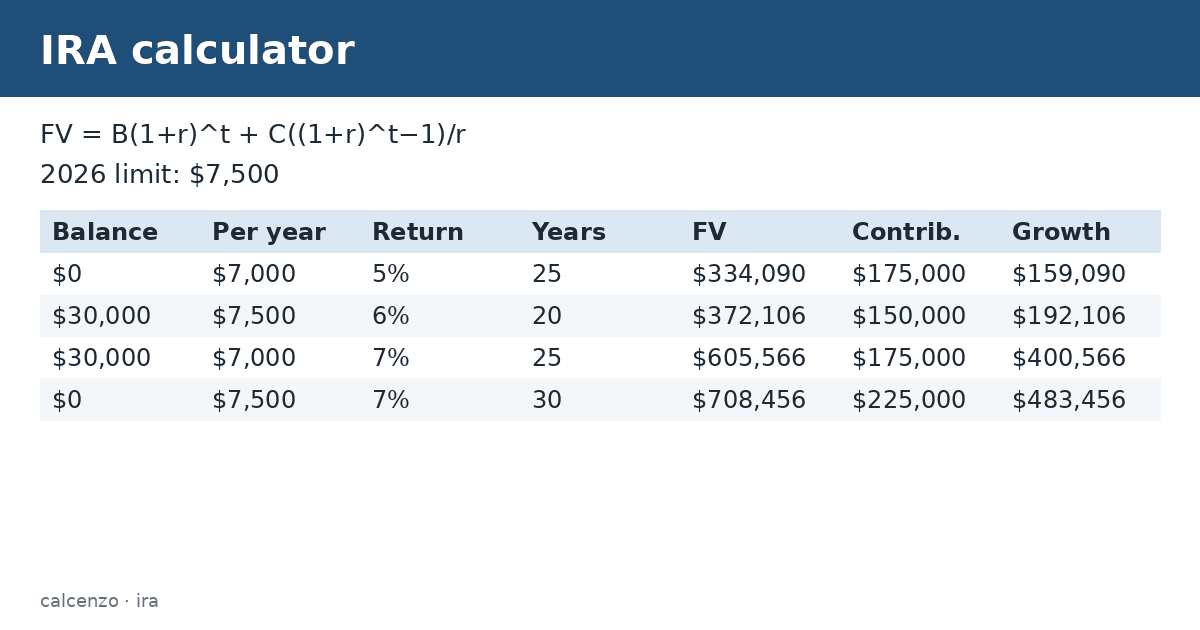
With $30,000 already saved, $7,000 added each year and a 7% return for 25 years, the IRA calculator projects about $605,566. Contributions total $175,000, so about $400,566 comes from growth. Contributing the 2026 maximum of $7,500 a year from zero for 30 years at 7% gives about $708,456.
| Balance | Per year | Return | Years | Future value | Contributions | Growth |
|---|---|---|---|---|---|---|
| $0 | $7,000 | 5% | 25 | $334,090 | $175,000 | $159,090 |
| $30,000 | $7,500 | 6% | 20 | $372,106 | $150,000 | $192,106 |
| $30,000 | $7,000 | 7% | 25 | $605,566 | $175,000 | $400,566 |
| $0 | $7,500 | 7% | 30 | $708,456 | $225,000 | $483,456 |
2026 IRA contribution limits
For 2026 the IRS limit on total contributions to all your traditional and Roth IRAs is $7,500, up from $7,000 in 2025. People aged 50 or older can add a catch-up contribution of $1,100, for $8,600 in total. You cannot contribute more than your taxable compensation for the year. The IRA calculator checks the limit for your age and shows an error if the annual contribution is above it.
Traditional or Roth
Traditional IRA contributions may be tax-deductible, and withdrawals are taxed as income. Roth IRA contributions are made after tax, and qualified withdrawals are tax-free. For 2026, if you are covered by a workplace plan, the traditional IRA deduction phases out between $81,000 and $91,000 of modified AGI for single filers and between $129,000 and $149,000 for married couples filing jointly. The IRA calculator shows the account balance before any tax on withdrawals, so a traditional balance will be worth less after tax than the same Roth balance.
Tips
- Contributions for a tax year can be made until the filing deadline the next April.
- Use a lower return to allow for fees and bad years.
- Withdrawals before age 59½ may face a 10% additional tax unless an exception applies.
Estimates for education only, not tax, legal or financial advice. Check current rules with the tax authority or a qualified adviser.
Rollovers and required distributions
Money you roll over from a former employer’s 401(k) into an IRA does not count toward the yearly contribution limit, so you can add the rollover amount to the current balance field. A direct rollover, where the plan pays the IRA custodian, avoids mandatory withholding. Only one indirect IRA-to-IRA rollover is allowed in any 12-month period, so trustee-to-trustee transfers are usually simpler.
Traditional IRAs eventually require minimum distributions, which currently start at age 73 for most owners, while Roth IRAs have no required distributions during the owner’s life. When you plan the later years, remember that withdrawals reduce the balance and that a traditional IRA’s balance is partly owed in tax. Check the projection each year against your statement and adjust the contribution if your income or goals change. If you are close to retirement, a lower return assumption is usually safer, because there is less time to recover from a market fall. Spouses without earnings can also fund a spousal IRA based on the working spouse’s compensation when filing jointly.
Related converters and calculators
Related calculators:
- Roth IRA calculator: Roth IRAs
- 401k calculator: workplace plans
- Retirement calculator: retirement
- Investment calculator: monthly investing
For health savings, the HSA contribution calculator works out your yearly limit. Saving for a child? See the Trump account calculator.
Sources
IRS: IRA contribution limits; IRS IR-2025-111: 401(k) limit increases to $24,500 for 2026, IRA limit increases to $7,500; IRS: COLA increases for dollar limitations on benefits and contributions.
Formula and method
FV = fvAnnual(P, PMT, rate%, years). Contribution must be ≤ $7,500 (or $8,600 at age 50+). Growth = FV − P − PMT × years.
Annual compounding with end-of-year contributions. Rejects contributions above the 2026 IRA limit. Not a tax engine.
Questions about this calculator
What is the 2026 IRA limit?
$7,500, plus a $1,100 catch-up at age 50 or older.
How does it compound?
Once a year, with contributions at year end.
Does it include taxes?
No. Traditional IRA withdrawals are taxed later.
Is the limit per account?
No, it covers all your traditional and Roth IRAs together.
Can I contribute more than I earn?
No, contributions cannot exceed taxable compensation.
Check the assumptions and units before relying on a result. Financial, tax and health estimates do not replace advice for your individual circumstances.
Report a calculation issue