
A Roth IRA calculator projects how a Roth IRA could grow from a starting balance and yearly contributions. $20,000 plus $7,000 a year at 7% for 30 years grows to about $813,471.
On this page
How to use the roth ira calculator
- Enter your current Roth IRA balance.
- Enter your yearly contribution.
- Enter an expected return.
- Enter the number of years.
- Read the future value and growth.
How the Roth IRA calculator works
The Roth IRA calculator projects the value of a Roth IRA from a starting balance, a yearly contribution, an expected return and a number of years. It compounds once a year and adds each contribution at the end of the year:
- FV = P(1 + r)ⁿ + C × ((1 + r)ⁿ − 1) ÷ r
P is the starting balance, C the yearly contribution, r the yearly return and n the years. It shows the future value, total contributions and growth. Because qualified Roth withdrawals are tax-free, the projected balance is what you could spend in retirement, with no income tax owed on it.
Roth IRA calculator worked example
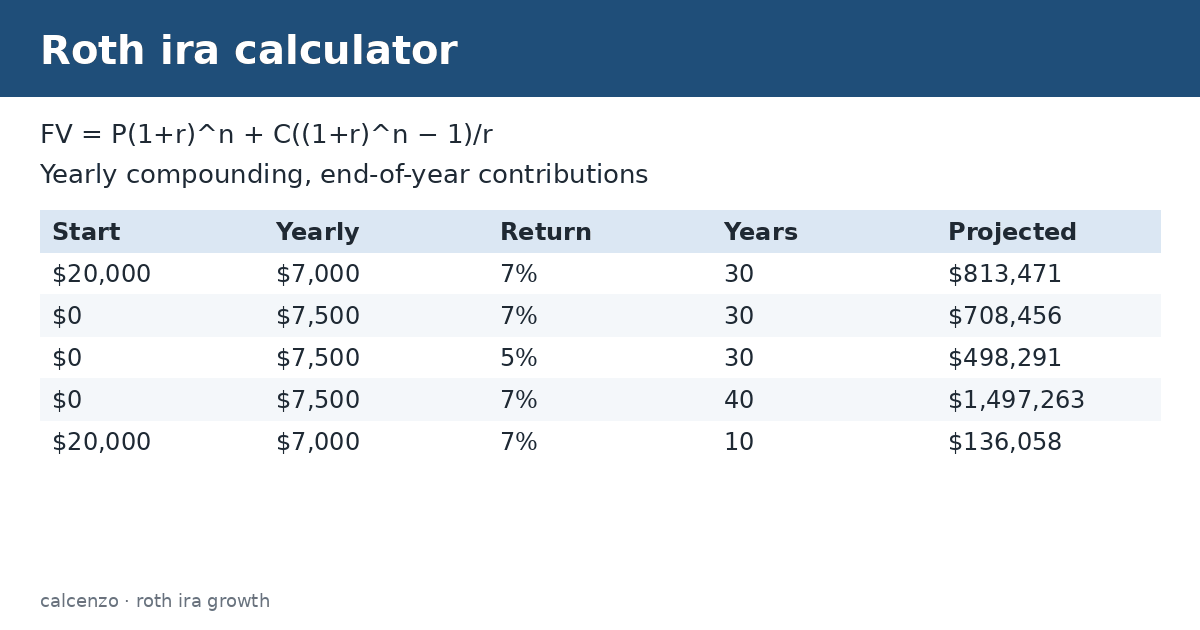
You have $20,000 in a Roth IRA and add $7,000 a year. At 7% for 30 years, the Roth IRA calculator projects about $813,471. You contribute $210,000 over that time. The starting $20,000 grows to about $152,245, and the remaining $451,226 or so is growth on your contributions. The table shows other cases.
| Start | Yearly | Return | Years | Projected |
|---|---|---|---|---|
| $20,000 | $7,000 | 7% | 30 | $813,471 |
| $0 | $7,500 | 7% | 30 | $708,456 |
| $0 | $7,500 | 5% | 30 | $498,291 |
| $0 | $7,500 | 7% | 40 | $1,497,263 |
| $20,000 | $7,000 | 7% | 10 | $136,058 |
2026 contribution limits
For 2026, the IRS limit for all your IRAs combined is $7,500, plus a $1,100 catch-up if you are 50 or older, so $8,600. You cannot put in more than your taxable compensation for the year. Enter your age and the calculator checks your yearly figure against the 2026 limit for that age, rejecting $7,600 at 45 or $8,700 at 55. It also reminds you that the Roth limit is reduced for 2026 modified AGI from $153,000 to $168,000 if single, or $242,000 to $252,000 if married filing jointly. You can make contributions for a tax year up to the tax filing deadline of the following year.
Income limits
Roth IRA eligibility phases out at higher incomes. For 2026, the phase-out range for modified adjusted gross income is $153,000 to $168,000 for single and head-of-household filers and $242,000 to $252,000 for married couples filing jointly. It is $0 to $10,000 for married filing separately if you lived with your spouse. Above the range you cannot contribute directly. IRS Publication 590-A explains how to work out a reduced limit.
Withdrawal rules
You can take out your own contributions at any time, tax- and penalty-free. Earnings are tax-free in a qualified distribution: the account must be at least five years old and you must be 59½, disabled or meet another listed exception. Roth IRAs have no required minimum distributions while you are alive, so the money can keep growing.
Roth or traditional?
A traditional IRA may give a deduction now, with tax paid on withdrawals. A Roth IRA gives no deduction now, but qualified withdrawals are tax-free. If you expect a higher tax rate in retirement than today, the Roth is usually better. Many people hold both to spread the risk of future tax changes. The Roth IRA calculator shows growth only and does not compare taxes.
Assumptions
Returns are not guaranteed and vary from year to year. The projection is in future dollars, so inflation will reduce its buying power. Fees cut returns directly. Try a cautious rate such as 5%, and treat the Roth IRA calculator result as one scenario. Running a low, middle and high rate gives a range that is more useful for planning than a single number, and shows how much the outcome depends on markets you cannot control.
Tips
- Contribute early in the year to give money more time to grow.
- Check your income against the phase-out range.
- Use the Roth IRA calculator with several return rates.
- Keep records of your contributions.
Estimates for education only, not financial advice. Your lender’s figures are final.
Related converters and calculators
Related calculators:
- IRA calculator: traditional IRA
- 401(k) calculator: workplace plan
- Retirement calculator: planning
- RMD calculator: distributions
Moving money from a traditional IRA? The Roth conversion calculator estimates the tax on a conversion.
Sources
IRS: Roth IRAs; IRS Publication 590-A: Contributions to IRAs; IRS IR-2025-111: 401(k) limit increases to $24,500 for 2026, IRA limit increases to $7,500.
Formula and method
r = rate/100. If years=0: FV=P. If r=0: FV=P+PMT*years. Else FV = P*(1+r)^years + PMT*((1+r)^years - 1)/r. Contributions total = PMT*years. Growth = FV - P - contributions.
Annual contribution assumed at end of each year (ordinary annuity). Constant annual return. No contribution limits, taxes, or conversion rules applied.
Questions about this calculator
What is the 2026 Roth IRA limit?
$7,500, or $8,600 at age 50 and over.
Are Roth withdrawals taxed?
Qualified withdrawals are tax-free.
Is there an income limit?
Yes; for 2026 it phases out from $153,000 single and $242,000 joint.
Do Roth IRAs have RMDs?
Not for the original owner.
How does it compound?
Yearly, with contributions at year end.
Check the assumptions and units before relying on a result. Financial, tax and health estimates do not replace advice for your individual circumstances.
Report a calculation issue