
An RMD calculator estimates the required minimum distribution you must take each year from a traditional IRA or workplace plan. Formula: RMD = balance / life expectancy factor(age). Factor from Uniform Lifetime Table sketch (age 72-120). Age must be >= selected start age (72 or 73). A $400,000 balance at age 75 gives about $16,260, using the IRS factor of 24.6.
On this page
How to use the rmd calculator
- Enter the account balance on December 31 of last year.
- Enter your age at the end of this year.
- Choose your RMD start age: 72, 73 or 75.
- Read the factor and the estimated RMD.
How the RMD calculator works
The RMD calculator estimates a required minimum distribution from a traditional IRA or a similar account. It divides the account balance on December 31 of the prior year by a distribution period from the IRS Uniform Lifetime Table:
- RMD = prior year-end balance ÷ distribution period for your age
You enter the balance, your age at the end of the distribution year and your RMD start age: 72, 73 or 75. The tool refuses an age below the start age you pick. It shows the factor it used and the estimated amount for the year.
RMD calculator worked example
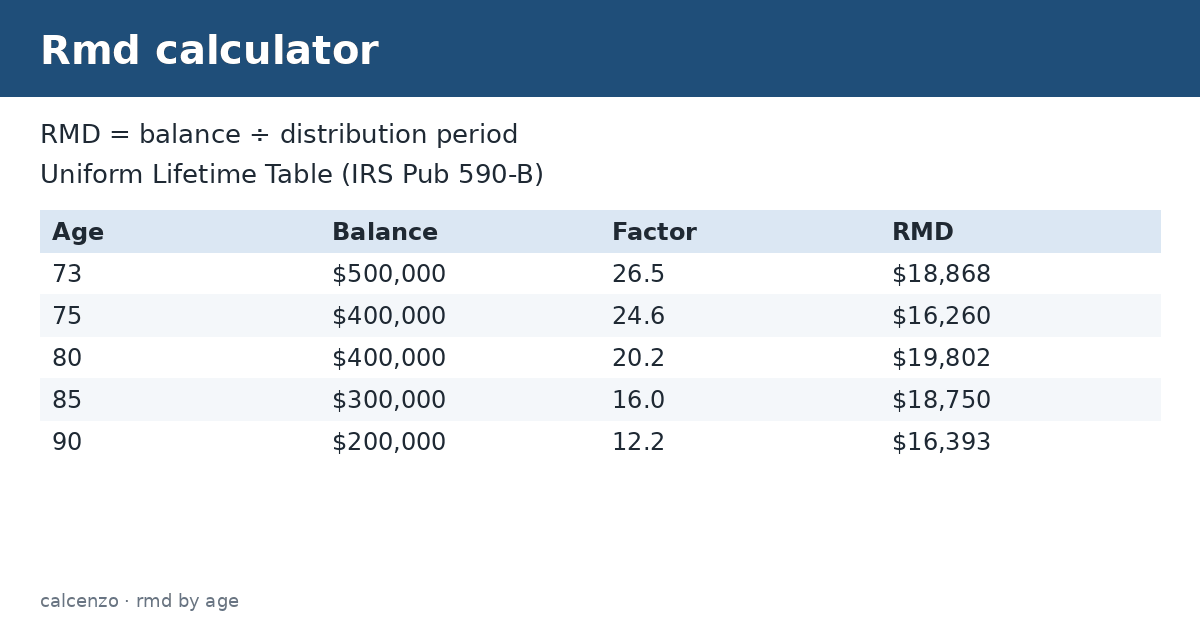
You are 75 this year and your IRA held $400,000 on December 31 of last year. The Uniform Lifetime Table gives 24.6 for age 75, so the RMD calculator returns $400,000 ÷ 24.6 ≈ $16,260. That is the least you must take out by December 31. You may always withdraw more. The table shows how the factor shrinks, so the share you must withdraw rises with age.
| Age | Balance | Factor | RMD |
|---|---|---|---|
| 73 | $500,000 | 26.5 | $18,868 |
| 75 | $400,000 | 24.6 | $16,260 |
| 80 | $400,000 | 20.2 | $19,802 |
| 85 | $300,000 | 16.0 | $18,750 |
| 90 | $200,000 | 12.2 | $16,393 |
When RMDs start
The SECURE 2.0 Act raised the starting age. It is 73 for people born from 1951 to 1959 and 75 for people born in 1960 or later. Those who turned 72 before 2023 started under the older rules. Your first RMD can wait until April 1 of the year after you reach the start age, but every later one is due by December 31. Delaying the first one means taking two RMDs in one year, which can push you into a higher tax bracket.
Which table applies
Most owners use the Uniform Lifetime Table, the one built into this tool. If your spouse is the sole beneficiary and more than 10 years younger, the Joint Life and Last Survivor Table gives a longer period and a smaller RMD. Inherited accounts follow different rules; use the inherited IRA RMD calculator for those. The full tables are in IRS Publication 590-B.
Accounts that need RMDs
Traditional, SEP and SIMPLE IRAs require RMDs, as do most 401(k), 403(b) and 457(b) plans. Roth IRAs have no RMDs while the owner is alive, and since 2024 neither do designated Roth accounts in workplace plans. Work out each IRA separately; you may then take the IRA total from any one or more of them. Workplace plans usually must pay each RMD from that plan.
Missing an RMD
If you take less than the required amount, the shortfall faces an excise tax of 25%. It drops to 10% if you correct it in time, and the IRS may waive it for reasonable error if you fix the shortfall. Use the RMD calculator early in the year, set up automatic withdrawals if your custodian offers them, and keep the year-end statement that the figure is based on.
What the tool does not cover
The RMD calculator follows the IRS table to its last row, “120 and over”, which uses a factor of 2.0, and it accepts ages up to 125. It does not estimate taxes, which apply at ordinary income rates unless the money goes to charity through a qualified charitable distribution. It also does not use the joint-life table.
Tips
- Use the balance from December 31 of the prior year, not today’s value.
- Enter your age as of your birthday in the distribution year.
- Recalculate each year, since the factor and the balance both change.
- Confirm the result with your custodian or a tax professional.
Estimates for education only, not financial advice. Your lender’s figures are final.
Related converters and calculators
Related calculators:
- Inherited IRA RMD calculator: beneficiaries
- IRA calculator: growth
- Retirement calculator: planning
- Roth IRA calculator: no RMDs
Sources
IRS: Retirement topics, required minimum distributions (RMDs); IRS Publication 590-B: Distributions from IRAs.
Formula and method
RMD = balance / life_expectancy_factor(age). Factor from Uniform Lifetime Table sketch (age 72-120). Age must be >= selected start age (72 or 73).
Educational Uniform Lifetime divisor sketch embedded in the plugin. IRS tables and your plan rules can change. Spouse-more-than-10-years-younger table is not used.
Questions about this calculator
How is an RMD calculated?
The prior year-end balance divided by the IRS distribution period for your age.
What age do RMDs start?
73 for people born 1951–1959 and 75 for those born in 1960 or later.
Do Roth IRAs have RMDs?
Not while the original owner is alive.
What if I miss an RMD?
A 25% excise tax, cut to 10% if corrected in time.
Which table does the tool use?
The Uniform Lifetime Table.
Check the assumptions and units before relying on a result. Financial, tax and health estimates do not replace advice for your individual circumstances.
Report a calculation issue