
A pension calculator projects how large your retirement savings pot could be by the time you stop working. $50,000 plus $6,000 a year at 5% for 25 years grows to about $455,680.
On this page
How to use the pension calculator
- Enter your current pension balance.
- Enter how much you and your employer add each year.
- Enter the expected annual return and years to retirement.
- Read the projected pot and total contributions.
How the pension calculator works
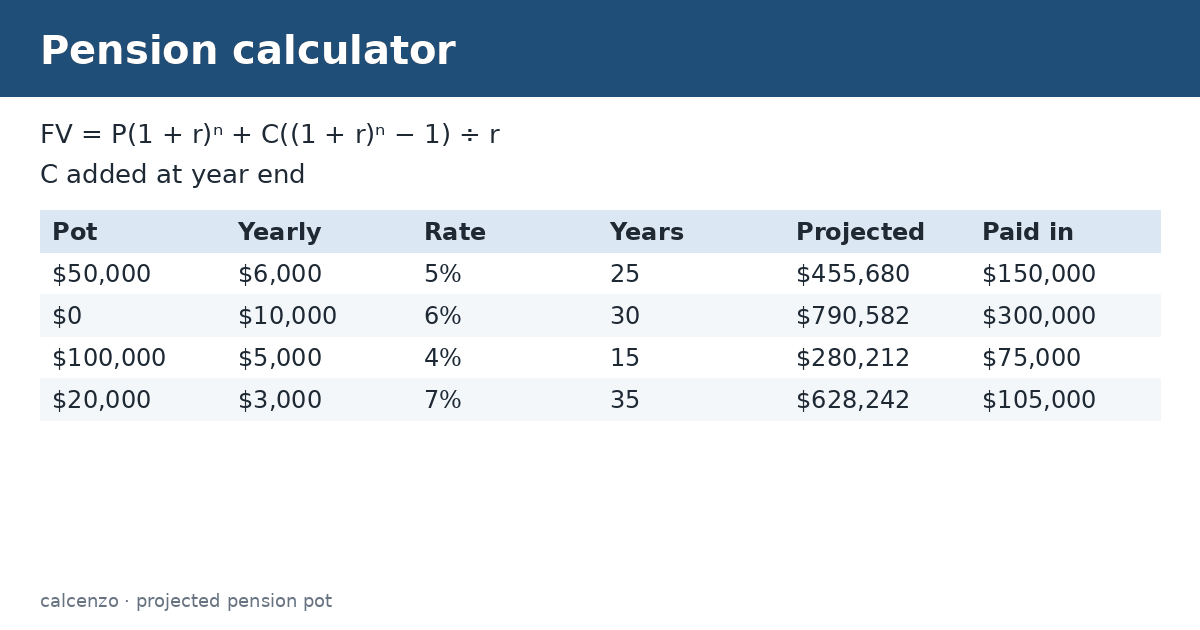
The pension calculator projects the value of a defined contribution pension pot, such as a workplace plan or personal pension, at retirement. You enter the current balance, the amount added each year, the expected annual return and the number of years until you retire. It grows the starting balance at the return rate and adds each year’s contribution at the end of the year: FV = P × (1 + r)ⁿ + C × ((1 + r)ⁿ − 1) ÷ r. It also shows the total you contributed, so the rest is investment growth.
Pension calculator worked example
You have $50,000 saved, add $6,000 a year, and expect 5% a year for 25 years. The pension calculator projects about $455,680, of which $150,000 is new contributions and the rest comes from the starting balance and growth. Starting from zero with $10,000 a year at 6% for 30 years gives about $790,582. The table shows other cases.
| Current pot | Yearly contribution | Return | Years | Projected pot | Contributions |
|---|---|---|---|---|---|
| $50,000 | $6,000 | 5% | 25 | $455,680 | $150,000 |
| $0 | $10,000 | 6% | 30 | $790,582 | $300,000 |
| $100,000 | $5,000 | 4% | 15 | $280,212 | $75,000 |
| $20,000 | $3,000 | 7% | 35 | $628,242 | $105,000 |
Think in today’s money
The projection is in future dollars. Prices rise over 25 or 30 years, so $455,680 then will buy much less than it would today. A simple fix is to enter a real return, the expected return minus inflation. If you expect 6% returns and 2.5% inflation, use about 3.5%, and the result is roughly in today’s purchasing power. Fees also reduce returns: a 1% annual fee can cut a 30-year pot by around a fifth, so subtract fees from the rate too.
From pot to income
A pot is not an income. At retirement you can buy an annuity, draw down gradually, or combine both. A common rule of thumb is that withdrawing about 4% of the pot in the first year, then adjusting for inflation, has historically lasted around 30 years in many markets, though it is not guaranteed. On that basis a $455,680 pot might support roughly $18,000 a year before tax. Add government benefits such as Social Security to estimate total retirement income.
Defined benefit pensions
If you have a defined benefit (final salary or career average) pension, this pension calculator does not apply directly, because your income is set by a formula based on salary and years of service rather than by a pot. Check your plan statement for your projected benefit. In the United States, the Pension Benefit Guaranty Corporation insures most private-sector defined benefit plans up to legal limits if a plan ends without enough money.
Ways to grow the pot
Contributing earlier has the biggest effect, because each dollar has longer to compound. Take any employer match in full; it is an immediate return on your contribution. Raise contributions when you get a pay rise. Keep costs low with broad index funds where available, and review your asset mix as retirement approaches. Use the pension calculator to test how an extra $1,000 a year or two more working years changes the outcome.
Tips
- Include employer contributions in the yearly amount.
- Use a cautious return, net of fees.
- Rerun the projection every year with your actual balance.
- Check tax rules and contribution limits for your country.
How much to contribute
Work backwards from the income you want. If you aim for $30,000 a year from savings and use the 4% guide, you need a pot of about $750,000. Try different yearly contributions in the pension calculator until the projection reaches that target, then check the figure is affordable.
Estimates for education only, not financial advice. Your lender’s figures are final.
Related converters and calculators
Related calculators:
- Retirement calculator: retirement plan
- 401(k) calculator: 401(k) growth
- Annuity payout calculator: income from a pot
- Social Security calculator: benefits
Sources
PBGC: Workers and retirees; Investor.gov (SEC): Compound interest calculator.
Formula and method
FV = P*(1+r)^n + PMT*(( (1+r)^n - 1 ) / r) with r = rate/100 (r=0 => P + PMT*n).
Annual contribution future-value sketch (fvAnnual). Not a plan-specific DB formula, COLA table, or tax engine.
Questions about this calculator
What does it project?
The value of a defined contribution pot at retirement.
When are contributions added?
At the end of each year.
Does it adjust for inflation?
No; enter a real return to see today’s money.
Does it work for final salary pensions?
No, those use a benefit formula.
What return should I use?
A cautious figure net of fees, such as 4% to 6%.
Check the assumptions and units before relying on a result. Financial, tax and health estimates do not replace advice for your individual circumstances.
Report a calculation issue