
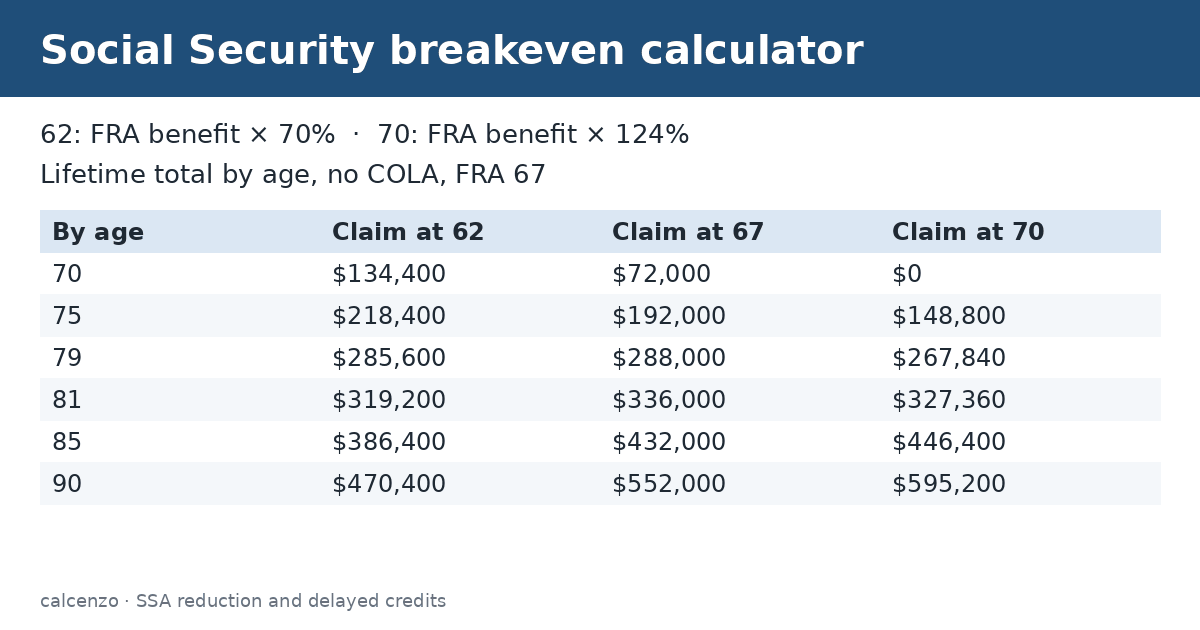
A Social Security breakeven calculator shows the age at which waiting to claim benefits pays back the checks you gave up by not claiming early. With a full retirement age of 67 and a $2,000 benefit, claiming at 62 pays $1,400 a month; waiting until 67 catches up at about age 78 and 8 months.
On this page
How to use the Social Security breakeven calculator
- Enter your monthly benefit at full retirement age from your SSA statement.
- Choose your full retirement age.
- Enter an assumed yearly cost-of-living adjustment (COLA).
- Enter a life expectancy age and read the breakeven age and lifetime totals.
What formula does the Social Security breakeven calculator use?
- Benefit at 62 = benefit at full retirement age (FRA) × 70% if your FRA is 67, or × 75% if it is 66
- Benefit at 70 = FRA benefit × 124% if your FRA is 67 (8% a year of delayed credits for 3 years)
- Running total for each claiming age = monthly benefit × 12 for every year collected, raised each year by the COLA you assume
- Breakeven age = the first age at which the later claim’s running total catches up with the earlier claim’s
Social Security breakeven calculator worked example
Someone with an FRA of 67 and a $2,000 FRA benefit, with no COLA so the dollars are easy to follow:
| Claim at | Monthly benefit | Catches up with | Breakeven age |
|---|---|---|---|
| 62 | $1,400 | — | — |
| 67 (FRA) | $2,000 | claiming at 62 | about 78 and 8 months |
| 70 | $2,480 | claiming at 62 | about 80 and 4 months |
| 70 | $2,480 | claiming at 67 | about 82 and 6 months |
For example, waiting from 62 to 67 gives up 60 months × $1,400 = $84,000, and the extra $600 a month takes 140 months to make it back: 67 years plus 140 months is 78 years and 8 months. The calculator reports whole years, so it shows 78.
SSA reduction for claiming at 62
| Year of birth | Full retirement age | Benefit at 62 (of FRA amount) |
|---|---|---|
| 1943–1954 | 66 | 75% |
| 1955 | 66 and 2 months | 74.17% |
| 1956 | 66 and 4 months | 73.33% |
| 1957 | 66 and 6 months | 72.5% |
| 1958 | 66 and 8 months | 71.67% |
| 1959 | 66 and 10 months | 70.83% |
| 1960 and later | 67 | 70% |
Delayed retirement credits add 8% a year (2/3 of 1% a month) from FRA until 70; nothing is gained by waiting past 70.
What a breakeven age leaves out
- Survivor benefits: a widow or widower may receive the higher earner’s benefit, so delaying can protect a spouse who outlives you.
- Working before FRA: the earnings test can withhold benefits if you work while claiming early.
- Taxes and investment: part of your benefit may be taxable, and early benefits you invest could earn a return.
- Longevity: the decision is a bet on lifespan; your health and family history matter more than averages.
Get your own numbers
Your personal benefit estimates at 62, FRA and 70 are in your my Social Security account at ssa.gov. Enter the FRA figure from your statement in the Social Security breakeven calculator for the most accurate result.
Estimates for education only, not financial advice. Your lender’s figures are final.
Spouses and survivor benefits
For married couples, the claiming decision affects more than one person. When the higher earner dies, the surviving spouse can generally receive the larger of the two benefits. That means a higher earner who delays to 70 can raise the survivor benefit for the rest of the survivor’s life, which a single-person Social Security breakeven calculator does not show. Spousal benefits work differently: they stop growing at the spouse’s full retirement age, so waiting past that point does not raise a spousal benefit.
Because of this, couples often split their approach: the lower earner may claim earlier while the higher earner waits. Run the Social Security breakeven calculator for each spouse, then think about how long the longer-lived of the two is likely to survive, not just each person alone. SSA’s survivor benefits pages explain the rules in detail.
Working while claiming early
If you claim before full retirement age and keep working, the earnings test can temporarily withhold some benefits when your earnings exceed an annual limit. Withheld amounts are not lost: SSA recalculates your benefit at full retirement age to credit the months withheld. Still, it can make early claiming less useful while you are working.
Related converters and calculators
Related calculators:
- Social Security calculator: benefit estimate
- Retirement calculator: savings
- RMD calculator: withdrawals
- Pension calculator: income
Sources
SSA: Starting your retirement benefits early; SSA: Delayed retirement credits; SSA: When to start receiving retirement benefits.
Questions about this calculator
What is the Social Security breakeven age for 62 vs 67?
With no COLA it is about 78 years and 8 months, because $84,000 given up is repaid at $600 a month.
How much is my benefit cut at 62?
By 30% if your full retirement age is 67, and 25% if it is 66.
How much more do I get at 70?
8% for each year after full retirement age, so 124% of the FRA amount if FRA is 67.
Does waiting past 70 help?
No. Delayed credits stop at 70.
Is breakeven the only factor?
No. Survivor benefits, health, work plans and taxes also matter.
Check the assumptions and units before relying on a result. Financial, tax and health estimates do not replace advice for your individual circumstances.
Report a calculation issue